Trivia Nights Near Me: How to Find a Good Quiz Night
Type "trivia nights near me" into a map and you get a list of bars. What you don't get is the useful part: which quiz has a host you can actually hear, questions you can reason your way into, and a team cap that stops one table of twelve from winning every week.
This guide fills that gap. You'll learn where quiz nights really get listed, how to read the clues before you go, what happens on your first night, and how to join a team if you turn up on your own. There's a city section too, because an Irish table quiz and an Australian school trivia night are very different evenings. And if nothing near you is any good, we'll show you how to start one.
Key takeaways
- Search the way regulars do: the day of the week plus "quiz", "trivia" or the local word for it, then check the venue's own pages for the current night.
- Quizzes live in more places than pubs: breweries, libraries, cafes, charity fundraisers, quiz leagues and open quizzes.
- Judge a quiz on eight things before you commit: host, questions, team cap, pace, scoring, phone rule, prize and entry fee.
- Arrive 20 to 30 minutes early on your first night. Good quizzes fill their tables before the first question.
- Going alone works. Tell the host or the bar staff, or look for a team that needs a player. You can also open PingMap's live map of plans near you and see what people nearby have posted.
- Give a new quiz three weeks before you decide. Week one is mostly learning the rules.
- No good quiz nearby is a signal, not a dead end. Start one.
Contents
- How does trivia night work?
- How to find trivia nights near me tonight
- Which kind of quiz night suits you? A decision table
- How to judge a good quiz night before you commit
- What to expect at trivia night: your first visit
- Can you go to trivia night alone?
- How to win at trivia night (or stop coming last)
- How trivia nights change by city
- No good quiz nearby? Start one
- How PingMap helps you find or fill a quiz table
- Mistakes to avoid
- If this happens: quick fixes
- FAQ
- Your next step
How does trivia night work?
The basic shape is the same almost everywhere. Teams sit at tables, a host (the quizmaster) reads questions in rounds, and each team writes its answers on a sheet. At the end of a round, sheets are handed in or swapped with the next table for marking. Scores go up on a board or get read out, and the team with the most points at the end wins something, from a round of drinks to a bar tab or a cash pot built from entry fees.
So how do pub trivia nights work in practice? A typical evening runs about two hours. One big US quiz company, Geeks Who Drink, uses a fixed format of eight rounds of eight questions. Pub quizzes elsewhere often mix a general knowledge round, a picture round, a music round and one or two specialist rounds. Common extras:
- Jokers. Each team picks one round to score double. Play it on your strongest subject, before that round starts.
- Tiebreakers. Usually a number question ("How many steps are in the Eiffel Tower?") where the closest guess wins.
- Rollover or jackpot questions. Some pubs add one hard question each week, and the prize grows until someone gets it.
- Picture and handout rounds. A sheet on the table you can work on all evening, handed in at the break.
The trivia night rules that matter most are about phones and team size. Phones stay away, full stop. Team size is a house rule, so ask on the night.
The pub quiz has a commercial origin, which explains a lot. The modern pub quiz league is usually traced to 1976, when a company called Burns and Porter organised quiz teams in southern England and sold the idea to breweries as a way to fill pubs on slow evenings. It helps explain why so many quizzes still run on quiet weeknights rather than on a Saturday.
How to find trivia nights near me tonight
Most people search once, see three bars, and pick the closest. That's how you end up at a quiz with a broken microphone. Here's how to find trivia nights near me tonight, and how to find local trivia nights worth going back to for the rest of the week, in about fifteen minutes.
Search like a regular, not a tourist
Map apps and search engines match the words venues use, so try several:
- "trivia night near me" and "quiz night near me" (bars in the US, Canada and Australia lean towards "trivia"; the UK, Ireland and much of Asia say "quiz").
- "pub quiz near me" if you want the British-style general knowledge quiz.
- The day plus the word: "trivia night thursday near me" or "quiz Tuesday". Quizzes are weekly, and search engines often surface the venue's events listing when the day matches.
- The local name. In Philadelphia bar trivia is called Quizzo. In Ireland a fundraiser quiz is a "table quiz". In parts of India the serious events are "open quizzes".
Then do the step most people skip: open the venue's own pages. Quiz nights get moved, paused for the summer or cancelled when a host leaves, and a map listing can lag by months. A recent post showing last week's scoreboard is the best proof the quiz still runs.
Check the places listings hide
Some quiz nights never appear in a map search. Look here too:
- Quiz company venue lists. In North America and the UK, many bars buy their quiz from a company that runs the same questions at dozens of venues. Those companies usually publish a venue finder. Search "pub trivia" plus your city to find which companies operate locally.
- Event and group platforms. Meetup groups for quiz fans, Eventbrite and similar ticketing pages, and Facebook events catch themed nights, fundraisers and one-off specials.
- Your city's forum. Ask in the local subreddit or neighbourhood group: "Which quiz has the best host?" gets more honest answers than any review.
- Libraries, bookshops and breweries. These often run a monthly trivia night for adults with a calmer crowd, and some are free.
- Clubs and leagues. Quiz leagues, alumni clubs and quiz associations run open events where anyone can enter.
Look at what people nearby are planning
Not every quiz team is attached to a venue listing. Sometimes three friends are going to the Thursday quiz and need a fourth. That's the gap a live map fills. On PingMap you can see public plans near you, and you can post a quiz-night plan and choose who joins: "Quiz at the corner pub, need two more, 8 pm Thursday."
Which kind of quiz night suits you? A decision table
"Quiz night" covers at least six different evenings. Before you scroll through every result for trivia nights near me, pick the type that matches what you want, then pick a venue.
| Quiz type | Best for | Team size you'll see | How to find it | Watch out for |
|---|---|---|---|---|
| Pub general knowledge quiz | A weekly habit with a mix of topics | Often capped somewhere between 4 and 8; ask | Map search plus the pub's own pages | Big regular teams; hard rollover questions |
| Company-run bar trivia | A polished, predictable format in many cities | Often larger tables allowed | The quiz company's venue finder | Same questions across venues, so no surprises for regulars who move around |
| Themed trivia night (one show, band or film series) | Fans of that one thing | Varies; often sells out | Ticketing pages and venue social posts | Booking needed; you need real fan-level knowledge |
| Fundraiser quiz | A big, social night out with a cause | Fixed tables, often 4 (Ireland) or 10 (Australian schools) | Charity, club and school pages | Paid tables, raffles, long evenings |
| Quiz league or open quiz | Competitive players who want harder questions | Fixed by the league | Quiz associations and league sites | Steeper difficulty, stricter rules |
| Online or home quiz | Friends in different places, or a test run | Whatever fits your call or room | Your own group chat | Cheating is easy online, so trust matters |
If you're new to a city, start with a pub or company quiz: low commitment, weekly, easy to join. If you want a crowd and a reason to dress up, wait for a fundraiser. If you already win your local pub quiz most weeks, find an open quiz and get humbled.
How to judge a good quiz night before you commit
The best quiz in town is rarely the nearest one. Before you make it your regular, check these eight things. You can learn most of them from the venue's posts, a call, or one visit.
The eight checks
- The host. Can you hear every word? Does the quizmaster read each question twice, explain the rules up front, and keep to time? A good host makes a mediocre question set fun. A bad one ruins a great set.
- The questions. Good questions can be worked out. "Which is further north, Rome or New York?" is better than "In what year was a minor treaty signed?" Look for clear wording, sensible accepted spellings and up-to-date facts.
- The team cap. A cap keeps it fair. Without one, the table of eleven wins every week and everyone else stops coming.
- The pace. About two hours, with marking done during the next round, is the sweet spot. Quizzes that drag past 11 pm on a weeknight lose people.
- The scoring. Scores read out or posted after each round, and a clear way to query a mark.
- The phone rule. Is it stated, and is it enforced? One team quietly searching every answer spoils the whole room.
- The prize. It doesn't need to be big. Second-place prizes or a "best team name" award keep newer teams interested.
- The entry fee. Free quizzes rely on you buying food and drinks. Paid ones usually fund a cash prize or a charity. Either is fine; just know which you're walking into.
Green flags and red flags
Green flags: a host who posts the scoreboard online, a mix of rounds, regulars who greet newcomers, a booking system for tables, and a picture round you can see from every seat.
Red flags: the speaker crackles, one team has won for months, answers are marked inconsistently, and there's a TV sports match competing for attention. You can also search inside a venue's map reviews for "quiz" or "host"; a few honest lines there beat the star rating.
What to expect at trivia night: your first visit
Here's what to expect at trivia night the first time, so nothing catches you out.
Before you go
- Book if you can. Popular quizzes take table bookings. If they don't, arrive 20 to 30 minutes early.
- Pick your team size. Two to six is easy to seat almost anywhere. Bigger teams should check the cap first.
- Eat first or order early. Kitchens get swamped at the break.
What to bring to trivia night
Two pens (one always dies), some cash in case entry is paid at the table, a team name you can say out loud without wincing, and reading glasses if you need them for a picture round. Some fundraisers are bring-your-own food, so read the ticket. You don't need to bring answer sheets; the host hands them out.
On the night
The host explains the rules, sells or collects entry, and hands out sheets. Write your team name on every sheet. Pick one scribe with clear handwriting, because illegible answers get marked wrong. Whisper. Other tables can hear you, and the team behind you is not above stealing an answer.
When you disagree with a mark, raise it once, politely, at the end of the round. If you have a good reason, most hosts will listen. Arguing every point makes you the team everyone remembers for the wrong reason.
Can you go to trivia night alone?
Yes, and it's one of the easiest ways to meet people in a new city. Can you go to trivia night alone and actually play? Here are four ways.
- Ask the host or bar staff. Hosts often know which regular team is short this week. "Is anyone looking for a player?" is a normal question.
- Play as a team of one. Many quizzes allow it. You won't win, but you'll learn the format, and teams notice the solo player who scores well.
- Join a quiz group first. Meetup and similar groups often book one big table and split into teams on the night.
- Find a team before you leave home. People do post that they need a fourth. You can check the live map for quiz and game plans within 10 km, ask to join one that fits, and arrive already on a team.
Going solo gets easier after week two. Quiz regulars are a small world. Once a team has seen you answer the music round correctly, you'll be asked back.
How to win at trivia night (or stop coming last)
You don't need to know everything. You need a team that covers different things and a way of deciding fast. These quiz night tips come from the tables that win most weeks.
Build for coverage
A winning team has someone for sport, someone for music across decades, someone for geography and science, and someone who knows TV and celebrities. That rarely happens by accident. Our guide on how to build a pub quiz team that covers every category shows how to map the gaps and fill them.
Decide fast
Agree a rule before the night: the person most confident on a subject has the final say on that subject, and you don't change an answer without a real reason. Most changed answers go from right to wrong.
Play the joker and the tiebreaker well
Play the joker on your strongest round before you see the questions. For the tiebreaker, reason out loud from something you know rather than guessing. Two minutes of logic beats a wild number.
Train the picture round
The picture round is where teams pick up or drop the most easy points, because one person either knows a face or doesn't. Train it between quizzes. Try a free 10-face easy round with no sign-in, or test yourself with the eyes-only celebrity round, which is harder than any pub picture round. One honest note: many of our cards are deliberately edited parody composites, so you're training recognition under pressure, not studying real photographs. For a two-minute habit, the three-face daily celebrity quiz resets every day and needs a free Google sign-in.
How trivia nights change by city
The format travels, but local habits change where you look, what you pay and how the night feels. Here's how six very different cities do it.
London: the weekly pub quiz
London is pub quiz country, and the classic pub quiz London regulars play is a general knowledge quiz on a weeknight. Teams are often capped, many pubs take table bookings for their quiz, and the most popular ones fill early. Prizes range from a bar tab to a cash pot. Search "pub quiz" with your neighbourhood and the day, then check the pub's own site, because London pubs change quiz nights more often than you'd think.
Dublin: quizzes for a cause
In Ireland, "table quiz" often means a fundraiser. Charities, sports clubs and student unions sell tables, usually for teams of four, booked in advance, often with a raffle on the side. They're a brilliant night out and a good way into local life. Search that phrase plus "Dublin" and the month, and check charity and club pages as well as pubs. Weekly pub quizzes exist too, but the fundraiser version is the distinctly Irish one.
New York and Philadelphia: company-run bar trivia
In the US, many bars buy their trivia from companies that run the same format across many venues, and those companies list their venues online. New York also has a busy themed trivia scene built around single TV shows, musicians and film series, and those nights often need tickets. Down the road in Philadelphia, bar trivia goes by Quizzo, a name that traces back to a Jersey Shore bar in the early 1990s, according to Billy Penn's history of the name. Search "Quizzo" there and you'll find far more than with "trivia".
Melbourne: fundraiser trivia nights
In Australia, "trivia night" often means a school or club fundraiser. Tables of 10 are common, there's usually a dress-up theme with a prize for the best-dressed table, and many are bring-your-own food and drink. For a trivia night Melbourne locals rate, check school, sports club and community pages and ticketing sites, then add a weekly pub quiz for the weeks in between.
Dubai: quiz nights in licensed venues
Dubai has a strong quiz scene, but it lives in licensed venues: hotel bars, sports bars and golf club bars. Several well-known quizzes are hosted by local radio presenters, and most run on weeknights. Check each venue's age and ID rules before you go, and book, because the popular ones are full of long-standing teams. Local listings guides publish regular round-ups of the best quiz nights.
Bengaluru: open quizzes with a serious streak
India has a serious competitive quizzing culture, and Bengaluru is one of its centres. The Karnataka Quiz Association, founded in 1983, runs open quizzes that anyone can enter regardless of age, alongside college and school events. Pubs and breweries run lighter quiz nights too. If you want hard questions and a room that cheers a clever deduction, search "open quiz" with the city and follow the quiz clubs.
No good quiz nearby? Start one
If your search turns up nothing, or only quizzes you wouldn't go back to, you're in a good position: the demand is there and nobody is serving it. Starting a quiz is easier than it looks.
- Find a venue with a slow night. Ask a pub, cafe or brewery which weeknight is quietest. That pitch worked in 1976 and it still works.
- Start small. Four teams of four is a real quiz. Run it monthly before you try weekly.
- Borrow a proven running order. Our guide on how to host a trivia night people come back to covers rounds, marking, dispute rules and a league table.
- Make the picture round memorable. See picture round ideas that go beyond faces.
- Fill the first night. Friends will get you to week one. Strangers nearby keep it going. Browse plan ideas and quick templates for small groups, then post the quiz as a plan with a time, a place and a cap.
When it outgrows a casual monthly night, read PingMap's guide on how to turn a monthly quiz into a proper hobby club, with a cadence, shared jobs and a way to welcome new members.
How PingMap helps you find or fill a quiz table
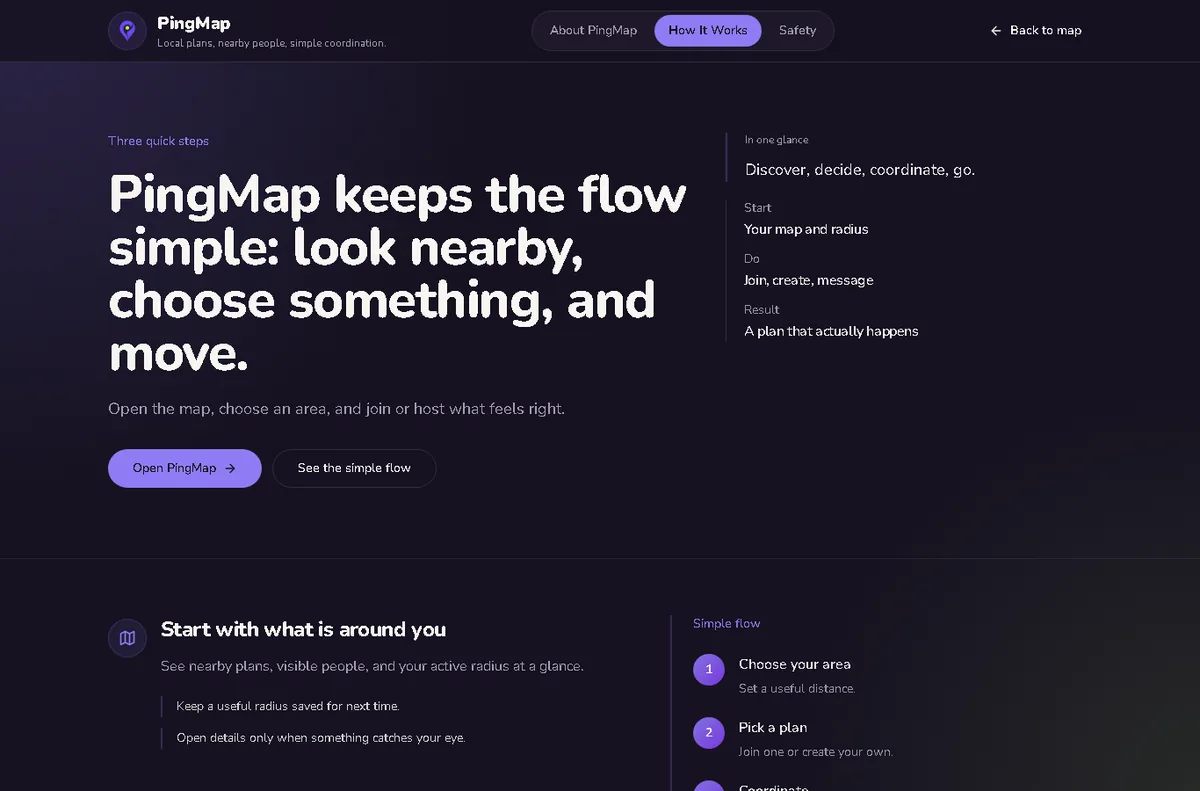
Most listings for trivia nights near me answer one question: where is the quiz? They don't tell you who is going and whether they need a player. That's the gap.
PingMap, a map-first app for local plans, shows public plans and people near you on one live map. It runs in the browser, you sign in with Google, and it's for adults (18+), which suits a pub quiz anyway. Here's how quiz players use it.
- Find a team. Browse plans within 10 km for free (Premium widens the radius to 50 km). Every plan type is free. Ask to join a quiz or game night that fits.
- Fill a seat. Post your own plan with the Game Night template or your own words: venue, time, how many players you need. Set a maximum number of people, and require approval so you choose who joins.
- Keep it organised. Each plan has its own chat, the plan room, for "who's booking the table" and "we're by the window".
- Make it weekly. After a plan ends, you can repeat it for next week from the same details.
- Control how visible you are. PingMap's Exact, Safe and Ghost presence modes let you show your precise spot, a softer area, or nothing at all on the map.
A note on meeting new people: a quiz is about the best possible first meeting, because it happens in a public venue with a clear start and end time. Still, read a request before you approve it, keep home addresses for people you know, and leave, block or report if anything feels off.
Mistakes to avoid
- Choosing by distance alone. A quiz ten minutes further away with a great host is worth the walk.
- Turning up at the start time. The good tables went 20 minutes ago.
- Bringing nine people to a quiz capped at six. Check the cap, or split into two teams and make it a rivalry.
- Using phones "just to check". It's cheating, the host will notice, and so will everyone else.
- Judging a quiz on one night. The first week is learning the format. Give it three.
- Ignoring the theme. A themed night on a show you've never seen is an expensive way to score four points.
- Arguing every mark. Pick your battles, and bring a source.
If this happens: quick fixes
The quiz you found isn't running. Listings go stale. Before you commit to a trivia night tonight, check the venue's latest posts or call. Keep a backup quiz on another night.
The pub is full. Ask to be added to a table with space, or play as a pair at the bar if the host allows it. Then book next time.
Your team keeps coming last. Look at which rounds you lose. Usually it's one or two categories. Recruit for those, and train the picture round between quizzes.
The host is hard to hear. Sit nearer the speaker next time, and mention it kindly at the break. Hosts often don't know the back of the room can't hear.
Half your team dropped out. Play as two, ask the host to pair you with another short team, or post a last-minute plan for the empty seats.
The questions are far too easy. You've outgrown it. Find a league or an open quiz, or start your own harder one.
FAQ
How do pub trivia nights work?
Teams of a few people sit together while a quizmaster reads questions in rounds, usually over about two hours. Each team writes answers on a sheet, which is marked after each round, often by swapping with another table. Scores are announced as you go, and the top team wins a prize. Many quizzes add a picture round, a music round, a joker (double points on one round) and a number-based tiebreaker. Phones stay away throughout.
Can you go to trivia night alone?
Yes. Tell the host or bar staff you're on your own; they often know a team that's short. Many quizzes also let you play as a team of one, which is a good way to learn the format. Quiz meetup groups usually welcome solo players and split them into teams on the night. You can also look for a team that has posted a plan nearby before you go, so you arrive with people to sit with.
What should you bring to trivia night?
Two pens, a little cash in case entry is paid at the table, a team name and, if you need them, reading glasses for the picture round. Answer sheets are provided. For fundraiser trivia nights, check the ticket: many Australian school nights, for example, are bring-your-own food and drink. Leave your phone in your pocket once the quiz starts, because looking at it can get your team disqualified.
What night of the week is trivia usually on?
Most bar trivia runs on quieter weeknights, often Monday to Thursday, because venues use it to fill slow evenings. That's been the pitch since the earliest commercial pub quiz leagues. Fundraisers and themed nights are more likely on a Friday or Saturday. To find trivia nights near me tonight, search the day name with "quiz" or "trivia", then confirm on the venue's own pages.
How many people should be on a trivia team?
Four to six is the sweet spot for most pub quizzes: enough to cover different subjects, few enough to agree quickly. Many venues cap teams, commonly somewhere between four and eight, so check the house rules. Irish fundraiser quizzes are often sold as tables of four, while Australian fundraiser nights often seat tables of ten. Pairs can do well at smaller, friendlier quizzes.
How does a trivia night fundraiser work?
A school, club or charity sells tickets or whole tables, and the money goes to the cause. On the night there's a quiz with a host, often a dress-up theme, and extras such as a raffle, an auction or paid games that raise more money. Prizes go to the winning table and sometimes the best-dressed one. Book early; popular trivia night fundraiser events sell out weeks ahead.
Are trivia nights free?
Many pub quizzes are free to enter and earn their keep through food and drink sales. Others charge a small entry fee per player, which usually funds a cash prize or a jackpot. Fundraisers charge more because the ticket is the donation. If price matters, check before you go, because the fee is rarely in the map listing.
Your next step
Pick two quizzes from your search, check that both still run, and go to each one twice before you choose a regular. Between quiz nights, warm up your picture round with a live celebrity quiz for up to 10 players, or browse more guides for quiz players and hosts. If board games are your other weeknight habit, our guide to finding a board game group near you uses the same tactics.
Short a player, or new in town with no team at all? Post the quiz as a plan on PingMap and learn how PingMap plan rooms keep your team in one chat from the first "who's in?" to the final score.