Board Game Groups Near Me: How to Find or Start One
Searching "board game groups near me" usually gets you a game store, two cafes and a Meetup page that last posted years ago. The good groups are out there. They just hide in store back rooms, library event calendars, forum threads and group chats.
This guide shows you where to look, in what order, and how to tell from the outside whether a group plays the kind of games you like. You'll get first-night etiquette that makes regulars want you back, a city section (a Seoul board game cafe and a Toronto one are not the same evening), and a step-by-step plan for starting your own group when nothing nearby fits.
Key takeaways
- Start with the friendly local game store. Open play nights there are the most reliable groups in most cities.
- Board game cafes are the easiest first step for beginners: staff teach rules, and you can play with friends while you scout the regulars.
- Check libraries, community centres, hobby-forum guilds, Meetup and your city's forums before you decide nothing exists.
- Judge a group by recent activity, the weight of games it plays, and whether newcomers get taught. Size matters less.
- On your first night, say it's your first time, ask to learn something light, and help pack away.
- If nothing fits, start one: a public venue, a fixed night, a cap and a short listing. You can browse board game plans on PingMap's live map to see who is already playing nearby.
Contents
- What counts as a board game group?
- How to find board game groups near me
- Which kind of group suits you? A decision table
- How to judge a group before you go
- Your first visit: how to fit in
- How board game groups change by city
- How to start a board game group
- How PingMap helps you find or fill a table
- Mistakes to avoid
- If this happens: quick fixes
- FAQ
- Your next step
What counts as a board game group?
"Board game group" covers several very different set-ups, and knowing the type saves you a wasted evening.
- Open game nights. A store, cafe or library hosts a regular night, and anyone can turn up and join a table. This is what most people mean by an open board game night.
- Clubs. A named group with organisers, a regular venue, sometimes a membership fee and a shared game collection. Many have run for years, and a search for "board game clubs near me" turns up the ones with websites.
- Meetups. Groups organised on Meetup or social media, often meeting at a cafe or pub. They range from casual to serious.
- Specialist groups. Heavy strategy, two-player games, wargames, tabletop role-playing or a single game played competitively. If you search "tabletop game groups near me", many results will be these.
- Private groups. Friends who play at each other's homes and occasionally open a seat to someone new. These are the hardest to find and often the best.
None of these is better than the others. A beginner looking for light games with new people wants an open night. Someone who has played a strategy game a dozen times wants a club or a specialist group.
How to find board game groups near me
Here's the order that works in almost any city. Give it an evening and you'll know what your area has.
1. Start at the friendly local game store
Hobby game stores are the backbone of the scene. Many run open play nights with free tables, and their staff know every group in town because those groups buy their games there. Go in, ask "Which groups play here, and on which nights?", and read the notice board. Many stores call their weekly event a tabletop game night, because card games and role-playing groups share the room, and a "board game night near me" search often surfaces these store events first. Stores also post their event calendars on their own sites and social pages.
2. Try a board game cafe
Search "board game cafe near me" and you'll find venues with a large game library, food and drink, and staff who teach rules at the table. Most charge a per-person play fee or ask for a minimum spend, so check before you go. Cafes are a great scouting trip: many run community nights or tournaments, and the staff know which regulars welcome new players.
3. Look at libraries and community centres
Public libraries increasingly run adult game nights, and some lend games. A board game library (a lending collection, run by a library, a cafe or a volunteer group) is also a natural meeting point for players. Community centres, universities and large employers often host games clubs that accept outsiders. These groups tend to be free and friendly to beginners.
4. Search Meetup, events pages and local forums
Search "board game meetup near me" on Meetup and on event and ticketing sites, then check Facebook groups, Instagram and Discord servers for your city's players. Your city's subreddit is worth a post too: "Looking for a weekly group that plays medium-weight games, any recommendations?" gets honest replies, including from private groups with a spare seat. This is also how to find board game friends who live close enough to play on a weeknight.
5. Check BoardGameGeek guilds
BoardGameGeek, the big hobby database and forum, has guilds: groups organised by region, city or interest. Many local guilds list where and when they meet, and members use the forums to arrange games. Search the guild list for your city, then your region, because some cover a whole metro area.
6. Go to a convention
A local games convention is the fastest shortcut there is. Hundreds of local players in one place, demo tables, and groups recruiting members. Even a small one-day event in a community hall will introduce you to three or four groups.
7. Check who's planning a game nearby
Some of the best tables aren't groups at all; they're four people who play on Thursdays and need a fifth. They rarely have a web page. On PingMap you can see public plans near you, then join a game-night plan or create one from a template. There are Game Night and Board Game templates, so "Two-player games at the cafe, 7 pm" takes a minute to post.
Which kind of group suits you? A decision table
| Group type | Typical games | Commitment | Cost | Best for | Watch out for |
|---|---|---|---|---|---|
| Store open play night | Mix, often new releases | Drop in | Usually free (buying at the store is appreciated) | Trying lots of games, meeting regulars | Crowded tables on release weeks |
| Board game cafe night | Light to medium, huge library | Drop in or book | Play fee or minimum spend | Beginners, friends, first meetings | Noisy rooms; time limits on tables |
| Library or community night | Light, classic and family | Drop in | Usually free | Quiet, friendly, low pressure | Limited hours; may close early |
| Meetup group | Depends on the organiser | Weekly or fortnightly RSVP | Free or a small venue fee | Finding a crowd with your taste | Groups that look active but aren't |
| Club or guild | Medium to heavy, member collections | Regular attendance | Sometimes a membership fee | Serious players who want depth | Insider culture, long games |
| Private home group | Whatever the host owns | High, fixed spots | Shared snacks | Close friendships, long campaigns | Hard to join; meet in public first |
Board games for adults range from ten-minute party games to four-hour strategy epics. "Weight" is the hobby word for complexity. If you're new, look for groups that describe themselves as playing light or "gateway" games, or that run a newcomers' table.
How to judge a group before you go
Not every result for board game groups near me is worth your Thursday evening. You can learn most of what matters from a group's listing, posts and photos.
Signs a group is a good fit
- Recent activity. Posts, RSVPs or photos from the last few weeks. A group whose last event was last spring is a ghost.
- Games you recognise. Photos of tables show what they really play. A shelf of heavy strategy games tells you something different from a pile of party games.
- Teaching culture. "Newcomers welcome, we'll teach" is the phrase you want. Groups that say it usually mean it.
- A clear venue and time. Public venue, regular slot, clear start time.
- A code of conduct. Larger groups often post one. It's a sign that someone is looking after the room.
Signs to keep looking
- Every event is "full" weeks ahead.
- The same game every week, played competitively, when you want variety.
- Hosts who never reply to questions.
- A first meeting at a stranger's home with no public option.
Five questions to ask the organiser
- What do you usually play, and how long do games run?
- Is there someone who teaches newcomers?
- How many people come on a typical night?
- Is there a fee, a minimum spend or a membership?
- Do I need to RSVP, and what happens if tables are full?
A friendly, specific reply within a day or two tells you more about a group than any photo. No reply at all tells you something too.
Board game social groups vary as much as people do. The right one for you is the one where you laughed at least once and got invited back.
Your first visit: how to fit in
Turning up to a room full of strangers bent over cardboard is mildly terrifying. These habits make it easy.
Before you go
- Message the organiser. "I'm new, is it fine to just turn up?" gets you a name to look for.
- Arrive at the start. Tables form in the first 20 minutes. Arrive late and you'll watch a two-hour game from the side.
- Bring something small if you like. A light game you know well is welcome at most open nights, but nobody expects it.
At the table
- Say it's your first time and ask what's being taught. Most groups have someone who loves explaining rules.
- Pick a light game first. Gateway games such as Ticket to Ride, Carcassonne, Azul, Splendor and Codenames are taught in minutes and show up at nearly every open night.
- Don't quarterback. In co-operative games, resist telling everyone else what to do.
- Handle the components carefully. Drinks off the table, food away from cards, and no shuffling someone's sleeved cards without asking.
- Keep your turn moving. Think during other people's turns.
- Help pack away. It's the single fastest way to be invited back.
Meeting new players safely
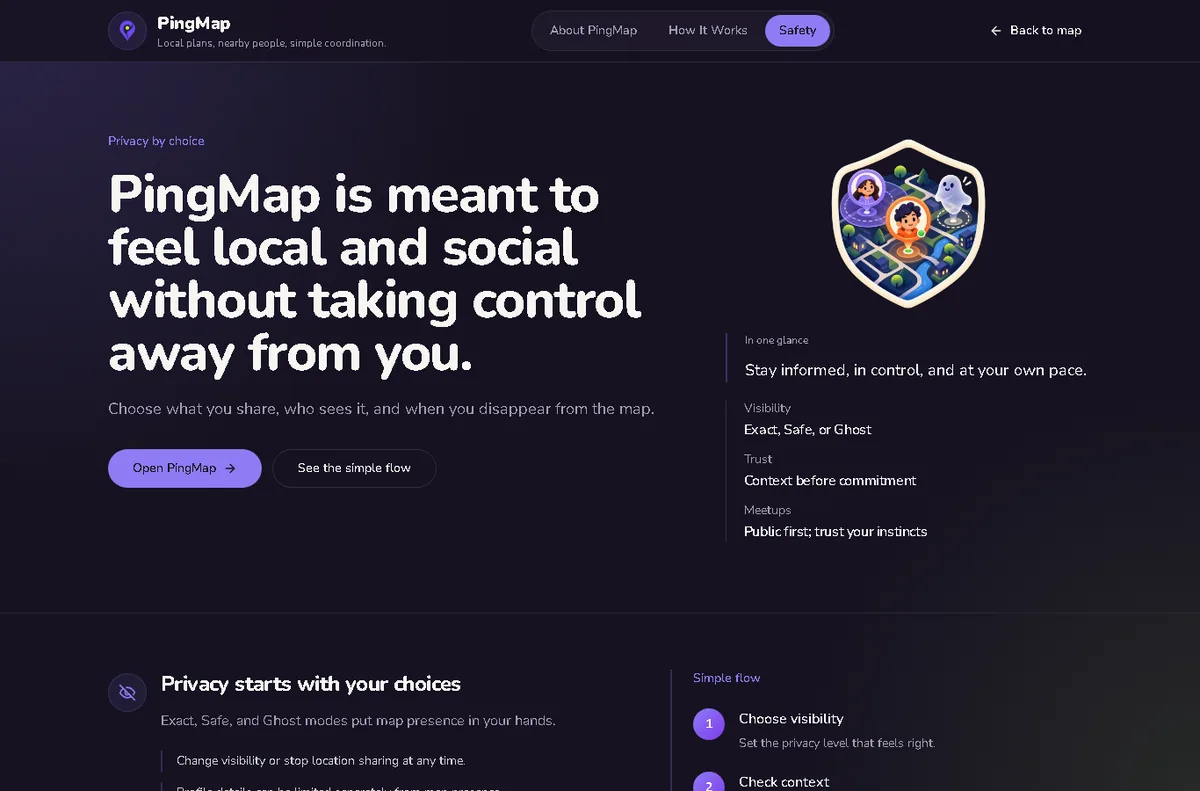
Board game groups are among the friendliest social settings there are, but treat first meetings like any meeting with new people. Choose public venues until you know people. Tell a friend where you're going. If you use a map app to find a table, check how visible you are; on PingMap, for example, you can use Safe mode that softens your exact pin on the map instead of showing your precise spot. And leave any group where something feels off, however good the games are.
How board game groups change by city
The hobby is global, but the way people find a table depends a lot on where they live. Here's how six very different cities do it.
Toronto: the cafe capital
Toronto's Snakes & Lattes opened in 2010 and is often credited with inspiring the wave of board game cafes across North America (it wasn't the first, despite the legend). Toronto still has a dense cafe scene, so a board game cafe Toronto search is the natural first step, and cafes are where many of the city's open nights and meetups gather. Book a table on weekends.
London: stores, pubs and a big convention up the road
London has everything: hobby stores with open play, board game cafes, pub back-room meetups and long-running clubs. A board game meetup London search returns dozens of groups, so filter by the weight of games and the night that suits you. Every late May or early June, UK Games Expo, which calls itself the largest hobby games convention in the UK, takes over the NEC in Birmingham, and many UK groups recruit there.
Berlin: a country that takes games seriously
Germany is the home of the modern hobby board game. The Spiel des Jahres (Game of the Year) award has been given since 1979, and SPIEL, held in Essen every October, is widely described as the hobby's biggest fair. In Berlin that culture shows up as well-stocked game stores, cafes and long-running clubs, plus plenty of groups that play in German. Check whether a group plays in English before you go, or treat it as language practice.
Seoul: where board game cafes took off
Board game cafes appear to have started in South Korea: by 2004 Seoul reportedly had around 130 of them. They are a mainstream night out there, often with friends rather than strangers, so the cafe is the venue and the group is whoever you bring. Expat and English-speaking groups organise through social media and meet at cafes that welcome them.
São Paulo: a fast-growing scene with its own database
Brazil's hobby has its own Portuguese-language home, Ludopedia, with rankings, reviews, events and its own annual award. Groups in São Paulo often organise there and on social media rather than on English-language sites, so search in Portuguese ("grupo de jogos de tabuleiro") to find the real scene.
Mumbai: ticketed sessions and community groups
In Mumbai, many board game meetups are ticketed sessions at cafes and bars, listed on event platforms, while community groups organise weekly nights on Instagram and Meetup. A board game cafe Mumbai search will show plenty of venues; the groups are on social media. Check the latest posts, because schedules change often.
How to start a board game group
If you've searched and nothing fits (wrong games, wrong night, too far away), start one. The demand is almost certainly there; nobody has hosted it yet. Here's how to start a board game group that's still running in six months.
Step 1: Pick a niche you can say in one line
"Light games after work, Tuesdays, beginners welcome." "Heavy strategy, Sundays, all afternoon." A specific line attracts the right people and saves arguments later. If you're wondering how to start a board game club rather than a casual group, the line is the same; you'll just add a name, a shared collection and roles later.
Step 2: Choose a public venue
A cafe, store, library room or pub back room. Ask the store or cafe which night is quiet; they'll often give you tables in exchange for the custom. Keep home games for later, once everyone knows each other.
Step 3: Fix a night and a cap
Same night, same place, every week or fortnight. Cap the numbers by tables: three tables of four is a great first target. A cap also makes RSVPs mean something.
Step 4: Write a short listing
What you play, who it's for, when and where, whether you'll teach, and how to say you're coming. For board game group names, keep it searchable: the area plus "Board Gamers" beats an in-joke nobody can spell.
Step 5: Fill the first night
Friends get you to night one. Strangers keep it going. Post the night where locals look, including the store notice board, Meetup and your city forum, and as a public plan on a live map. Need inspiration for the night itself? PingMap's plan ideas for your neighbourhood, from quick games to movie nights show how other people word a plan, and its guide to game night ideas for adults with a full running order helps when your group mixes gamers and newcomers.
Step 6: Keep it going
- Keep a newcomers' table every week with a light game and a teacher.
- Rotate who teaches and who brings games.
- Run a group chat for "who's coming" and "who's bringing what".
- Mix in other games now and then. A quick picture round between long games works well; a live multiplayer celebrity quiz for up to 10 players runs on everyone's phones, or play a quick 10-face easy round on a laptop while the next table finishes. If you want a tailored one, build a celebrity picture round from the library. Our cards are deliberately edited parody composites, which is half the fun.
Once you have regulars, you might add a league or ratings; our explainer on how Elo ratings work in quiz and strategy games shows how. And when the group grows into something bigger, PingMap's guide shows how to turn a weekly board game night into a hobby club, with roles and a cadence that doesn't burn out the organiser.
How PingMap helps you find or fill a table
Most results for board game groups near me tell you where groups meet. They rarely tell you that four people two streets away are starting a game in an hour and need a fifth.
PingMap, a live map for local plans, shows public plans and people near you on one map. It runs in the browser, sign-in is with Google, and it's for adults (18+). For board game players it does a few useful things:
- Find a table. Find board game players within 10 km for free; Premium widens that radius to 50 km. Every plan type is free.
- Post a game night. Use the Board Game or Game Night template, add the venue, time and games, and set a maximum number of players.
- Choose who joins. Make the plan public, friends only or invite only, and turn on approval so you see each request first.
- Talk in one place. Every plan has its own chat, the plan room, for "which games are we bringing?"
- Repeat it. When a game night ends, you can repeat it for next week with the same details.
- Stay private. Exact, Safe and Ghost presence modes control how visible you are on the map, and you can block or report anyone.
It works wherever people use it, so the map is only as busy as your area. If it's quiet near you, that's the cue to post the first plan.
Mistakes to avoid
- Giving up after one search. The best local board game groups rarely rank well. Ask at a store.
- Judging a group by one night. Different tables, different games. Go twice.
- Starting with a four-hour game. Learn the room with something light.
- Bringing your heaviest game to an open night. Nobody wants a 40-minute rules teach at 9 pm.
- Treating a cafe like free space. Pay the play fee or order food; that's what keeps the tables there.
- Starting a group without a cap. Fifteen people and two games is a bad night for everyone.
- Hosting strangers at home first. Public venue first, home games later.
If this happens: quick fixes
The group in the listing doesn't exist anymore. Ask the venue. Groups move more often than they close. The store staff usually know where they went.
Everyone already has a table when you arrive. Ask the organiser. Most will start a new light game or slot you into the next one. Arrive at the start next time.
The group plays only heavy games. Ask whether anyone wants a lighter game on the side, or look for a second group for lighter nights.
You're the only beginner. Say so. Experienced players often enjoy teaching, and a beginner-friendly game gets everyone involved.
Your new group's attendance is dropping. Check the night, the cap and the games. Usually one has drifted: the games got heavier, or the night moved. Fix it and post a fresh plan.
Nobody turned up to your first night. It happens. Play a two-player game with whoever came, post photos, and go again next week. Consistency is what builds a group.
FAQ
How do I find board game groups near me?
Start at hobby game stores, which often run open play nights and know every local group. Then check board game cafes, library and community-centre events, Meetup, BoardGameGeek guilds and your city's forums and social groups. Local conventions are a shortcut, because groups recruit there. You can also look for game-night plans posted near you on a live map. If you find board game groups near me listings that look stale, ask the venue: groups move more often than they stop.
Are there board game groups near me for adults?
Almost certainly. Most open game nights at stores, cafes and Meetup groups are adult-focused, and many evening events are adults-only by default because they run late or happen in bars. Look for listings that mention "adults" or "18+", or that meet in pubs and bars. Libraries often run separate adult game nights as well as family ones.
Can I join a board game group as a beginner?
Yes. Look for groups that say "newcomers welcome" or "we teach", or start at a board game cafe, where staff explain rules at your table. Tell people it's your first time and ask to learn a light game. Most players love teaching, and a beginner who helps pack away is invited back.
What should I bring to a board game night?
Nothing is required at most open nights. Bring a light game you know well if you'd like, plus a drink or snack if the venue allows it. At cafes, budget for the play fee or a minimum spend. Leave heavy, long games at home until you know the group, and ask before bringing food to a table with cards on it.
How do you start a board game club?
Pick a specific niche, find a public venue with a quiet night, fix a regular slot and cap numbers by tables. Write a short listing, post it where local players look, and fill night one with friends. Keep a newcomers' table and rotate teaching. Add a name, shared collection and roles once you have regulars.
How many people do you need for a board game group?
Four is enough for a first night: one table and one game. Most open nights work best with two to four tables of three to five players, so there's choice without chaos. Cap your numbers so RSVPs mean something. Smaller groups of two or three can thrive too, especially around two-player games.
Do board game cafes charge?
Most do. The usual models are a per-person play fee, a time-based fee or a minimum spend on food and drink. Prices vary by city and venue, so check the cafe's website before you go. In return you get a large game library and, often, staff who teach rules.
Your next step
Do the fifteen-minute version tonight: message one game store, look up one cafe and search one guild. You'll have three options by the weekend. If you like quiz nights as much as game nights, read how to find a good quiz night near you, and for big sporting evenings with friends there's watch party ideas for the nights there's a big match on. Hosting games and quizzes regularly? See our guide to running a regular quiz night and more guides for game nights and quiz nights.
And if nothing near you fits, be the group. Post a board game night and approve who joins, pick a public venue, and set up the first table.