How to Host a Quiz Night With Friends (and Keep People Coming Back)
The first quiz night is easy. Everyone is curious, someone brings snacks, and the arguments are funny. Night three is the real test. The person who wrote the questions is tired, two regulars cancel on the day, and the same team wins again.
This guide is about how to host a quiz night that survives night three. Not a one-off fundraiser with raffles and a hall to fill, but a quiz night with friends that turns into a habit: the same people, a fixed slot, and a reason to come back next month. You get a two-hour format, a brief for whoever writes the questions, a league table that forgives missed nights, dispute rules, and a plan for the evening half the table cancels.
Key takeaways
- Fix one night a month and stop renegotiating it. Monthly is easy to keep; weekly is easy to abandon.
- Five rounds of eight questions fills about two hours, with room for a break and a few arguments.
- Rotate the quizmaster so nobody burns out, and give each setter a short written brief.
- Keep the league table for people, not teams, and count each player's best six nights out of eight.
- Agree the dispute rules on night one and print them on the back of the answer sheet.
- Mix in a picture round and a phone round so the visual thinkers and the fast tappers get their moment.
- Plan for empty seats before they happen: a core, a bench, and a safe way to invite people nearby.
In this guide
- What you need before the first quiz night
- Pick a slot and protect it
- How to host a quiz night that fits in two hours
- How to write quiz questions people actually enjoy
- The picture round
- The phone round with Compete
- Rotate the quizmaster
- Keep a league table across nights
- Write the dispute rules before you need them
- How to make a quiz night fun when the same team keeps winning
- How to keep people coming back (and fill empty seats)
- Common mistakes that end a regular quiz night
- Troubleshooting: when the night goes wrong
- Your first-night checklist
- Quiz night FAQ
- Your next step
What you need before the first quiz night
Less than you think. A regular quiz night runs on four things: people, a place, a kit and a stack of questions. Sort them once and every later night is mostly copy and paste.
How many people you need
Six to twelve players is a comfortable size for a friends' league. That gives you two or three teams of three or four, which is enough for a proper race and small enough that everyone hears the questions without a microphone. Pub teams normally have four players, according to the Morning Advertiser's long-running advice for pubs, and four is a good default at home too.
Fewer than six and it feels like a pop quiz. More than twelve and the back table stops listening.
The kit list
- Answer sheets. One sheet per team with a box for each round. Print the dispute rules on the back (more on those below).
- Pens that work. Bring twice as many as you think you need.
- A timer. Any phone will do.
- A screen for the picture round. A TV with a laptop plugged in, or a phone cast to the TV.
- A league sheet. Paper on a clipboard or a shared spreadsheet. Every player's name goes on it.
- The question pack. Printed, with the answer and a source written next to every question.
- A trophy. The sillier the better. A plastic cup sprayed gold is perfect.
Home, cafe or pub: where to host a trivia night
Each venue changes the night a little. Pick the one that suits your group and keep it for a whole season.
| Venue | Good for | Watch out for |
|---|---|---|
| Your living room (a trivia night at home) | Free, relaxed, easy to hear, food your way | The host does the dishes. Only share your address with people you already know |
| A cafe on a quiet weekday | Neutral ground, food sorted, no one has to tidy | Ask about noise, table space and how long you can stay. Order enough to make the table worth it |
| A pub corner | Atmosphere and drinks | Noise, another quiz on the same night, and the venue's own age rules |
| A video call | Friends in different cities | Harder to stop searching. Lean on the phone round and screen sharing |
Cafe owners are often glad to fill a quiet weeknight. The same pub advice notes that quiz nights tend to land on quieter nights such as Tuesdays rather than Saturdays, because the point is filling the room.
Pick a slot and protect it
The first rule of how to host a quiz night that lasts: a regular night only works if nobody has to ask "are we doing it this week?"
- Choose one weekday and keep it. "Second Thursday of the month" beats "sometime next week" every time. Ask the group which night suits most people, then stop renegotiating.
- Start monthly. The Morning Advertiser's guide to running pub quizzes suggests testing with a one-off or monthly quiz before committing to weekly. That holds for friends too. Monthly is easy to keep; weekly is easy to abandon.
- Check for clashes. The same piece tells landlords to check which nearby pubs already run quizzes so they do not compete head on. For friends, the clashes are different: a big cricket match, month-end at work, exam season, festival weeks. Look at the calendar once and dodge the obvious ones.
- Fix the start and the end. People commit more easily to "8 to 10" than to "8 till whenever". Say both times in every invite.
- Book the next three dates before anyone goes home. Momentum is cheapest on the night itself, when everyone is still arguing about round four.
How to host a quiz night that fits in two hours
The pub standard is long. The Morning Advertiser reckons a ten-round quiz takes about two hours, with a break after round five. Friends talk more than pub teams, so cut it down. Five rounds of eight questions gives you 40 questions, room for a proper break, and time to argue about the answers.
The running order
| Round | What it is | Why it is there |
|---|---|---|
| 1 | General knowledge warm-up | Everyone scores, latecomers settle in |
| 2 | Picture round | Gives the visual thinkers their moment |
| 3 | The setter's theme round | Whatever the quizmaster loves, from cricket to 90s TV |
| Break | Food, refills, standings read out | Keeps the table social |
| 4 | Phone round | A fast, noisy change of pace |
| 5 | Mixed final round | The hardest questions, so the table can still flip |
How many rounds and questions should a quiz night have?
There is no official number. What matters is that the last round ends before people start checking the time. These are rough planning figures that include marking and a 15 minute break. Time your first night and adjust.
| Format | Rounds and questions | Rough length | Best for |
|---|---|---|---|
| Quick weeknight | 4 rounds of 8 | About 90 minutes | Work nights, small groups |
| Standard | 5 rounds of 8 | About 2 hours | Most friend groups |
| Big night | 6 rounds of 10 | 2.5 hours or more | Birthdays, the season finale |
If you are running late, cut a round, not the break. The break is where the league table gets read out and the trash talk starts.
Marking without stopping the night
Marking is where quiz nights quietly lose twenty minutes. Two ways to keep it moving:
- Swap and mark. Teams swap sheets and mark each other's while the host reads the answers. It is fast, and every disputed answer gets aired in public.
- Mark during the next round. The host or a helper marks round one while round two is being read. Scores go up on the league sheet at the break.
Either way, read every answer out loud. Half the fun is the groan when a team realises they had it right and crossed it out.
How to write quiz questions people actually enjoy
Good questions are the difference between a night people talk about and a night people politely survive. You do not need to be a trivia champion to write them. You need a brief and a habit of checking.
The setter's brief
Hand this to whoever is setting the next night:
- Eight questions per round. Five rounds, so 40 in total.
- At least two per round that most people will get. Nobody enjoys a round of zeros.
- At least one per round that only one team will get. That is where the table moves.
- Every answer checked against a source, written next to the question on the setter's copy.
- One topical question per round from the last month's news, sport or releases.
- Nothing that relies on one person's private knowledge. "What is my dog called?" is a party game, not a quiz.
The Morning Advertiser piece puts writing your own questions at three to four hours for eight or ten rounds of ten. A five-round friends' night takes less, but it is still an evening's work. That is exactly why the setter should rotate.
Five question shapes that keep a round lively
Straight "what is the capital of..." questions get dull fast. Mix in these shapes:
- Closest number. "How many steps to the top of...?" Nearest team wins the point. Keep two spare ones as tiebreakers.
- Which came first? Two events, two releases or two inventions. Easy to read, surprisingly hard to answer.
- The connection. Four answers in a round share a hidden link. A bonus point for the team that spots it.
- Multiple choice with a trap. Four options, one of which looks right and is not. This is exactly how a Guess the Celeb card works: four names, one of them a decoy.
- Finish the list. "Name the three..." Half points for two out of three keeps everyone in it.
Check every answer twice
- Use two sources for anything a smart person could argue with.
- Add "as of" to anything that changes: records, holders, populations, prices.
- Avoid "first", "biggest" and "only" unless the source is rock solid. Those words start fights.
- Read each question aloud to someone before the night. If they have to ask what you mean, rewrite it.
The picture round
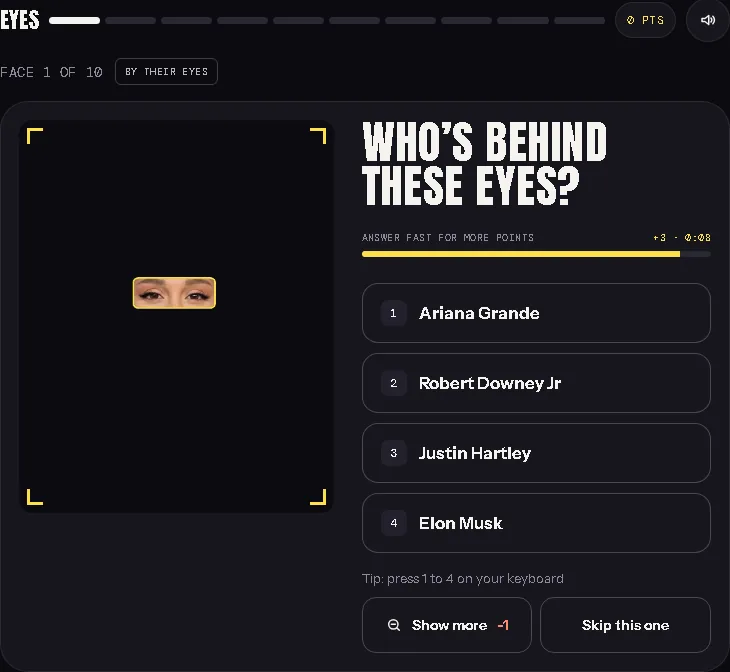
Faces are the classic picture round because everyone thinks they are good at them, and almost everyone is worse than they think. If you want something ready-made, put a round from guess the celebrity by their eyes on the big screen and have teams write their answers down instead of shouting them. For a gentler opener, a 10-face easy round you can play without signing in works on any laptop plugged into the TV.
One warning, in the spirit of fair play: many Guess the Celeb cards are deliberate parody composites. One star's eyes get pasted onto another star's face, and the name that matches the eyes is the decoy. The right answer is the person whose face it is.
These are edited images made for the game, not real photos, and the site explains how the game's edited images work. Tell teams before the round starts. Then enjoy the groan when the full image appears.
If the group starts asking how to tell a paste from the real thing, How to Spot a Face Swap: Six Tells You Can Check in Seconds makes a good bonus round of its own. When the group tires of faces altogether, rotate in other themes: Picture Round Ideas Beyond Famous Faces has twelve, with crop rules.
The phone round with Compete
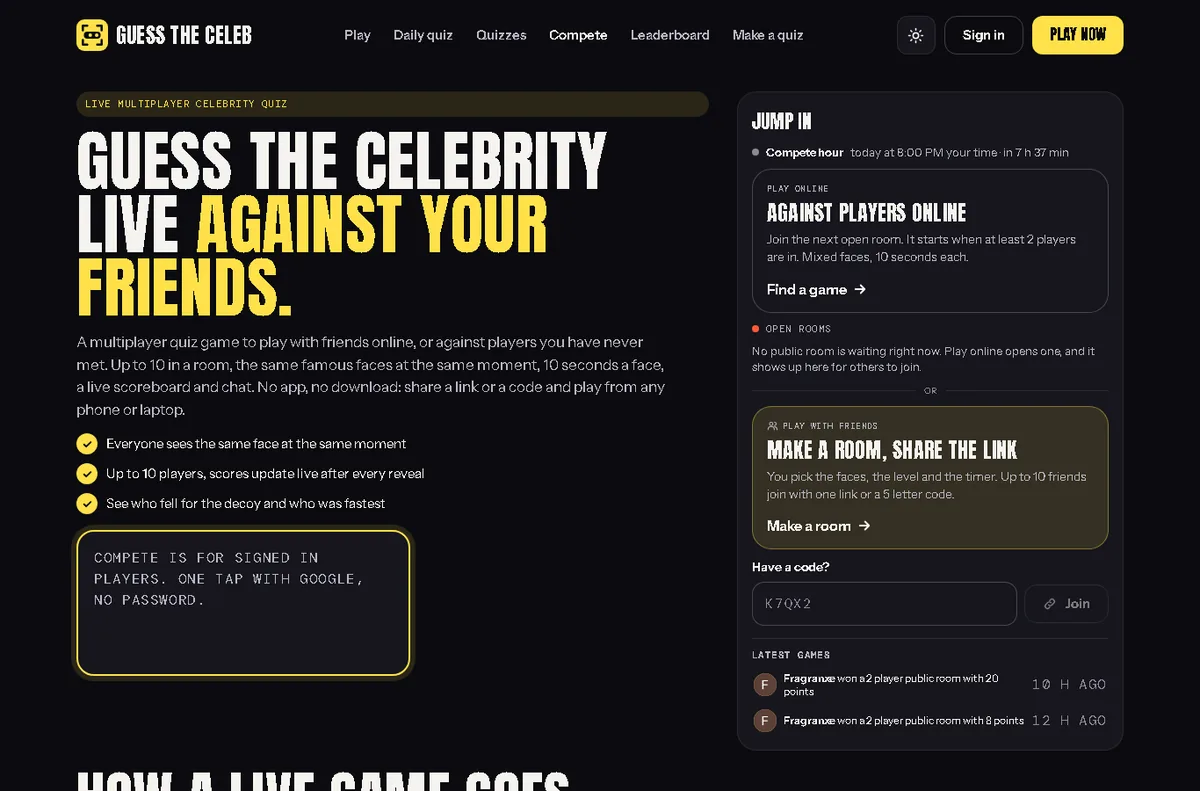
Round four is where the pens go down. With Compete, the live multiplayer celebrity quiz for up to 10 players, the quizmaster makes a room and each team joins on one phone with the link, a five-letter code or the QR code. A game needs at least 2 players and a room holds up to 10, so even a big night fits.
The host picks the level, the number of faces (5 to 20) and the timer (5, 10, 15 or 20 seconds a face). Eight faces at 10 seconds is a tidy round, and a full game takes two or three minutes. Everyone sees the same face at the same moment, and the reveal shows who picked what and how many fell for the decoy.
Three practical notes:
- Sort the sign-ins first. Each joining phone needs a free Google sign-in. Do it during the break, not while the room is waiting.
- Count correct answers for the league. Compete's own scoreboard gives faster right answers more points. For the league sheet, count correct answers, so this round weighs the same as the other four.
- Let the rating be a side game. Every Compete player starts at a rating of 1000, and Compete points count on the Guess the Celeb leaderboard like any round. Some groups enjoy tracking that between nights too.
Rotate the quizmaster
The fastest way to kill a regular quiz night is to make one person write every question. They burn out, and they never get to play.
- Make a rota at the start of the season. Each month a different person sets. Put the dates and names on the league sheet so nobody can claim they forgot.
- Split the job if it feels heavy. Two setters per night, each writing two or three rounds, halves the work and doubles the variety.
- The setter sits out but does not lose out. At the end of the season, give each setter their average score from the nights they played. Otherwise nobody volunteers.
- The setter owns round three. It is their chance to show off an obsession. That is a reward, and it makes each night feel personal.
- Give the setter shortcuts. The picture round can come straight from the game, or the setter can build your own picture round from the quiz library by mixing 3 to 10 famous faces into a quiz with a share link. Browsing quizzes made by other players is another quick source of ready rounds.
Keep a league table across nights
A single night has a winner. A league has a story. People come back to defend second place.
This is where a monthly quiz league beats a string of one-offs. A simple system that copes with missed nights:
- Placing points each night. First place 5, second 3, third 2, and 1 point for every other team that turned up and finished.
- Points go to people, not teams. Teams change as attendance changes, so each player banks their team's points.
- Best six of eight. Run a season of eight nights and count each person's best six. Weddings, deadlines and flu happen; the league forgives two of them.
- Read the standings out at the break. Not at the end. Mid-night standings change how the last two rounds feel.
- Keep the prize small. The Karnataka Quiz Association, which has organised quizzing in Bangalore since 1983, totals graded points across each season and describes its prizes as only tokens of recognition, usually book coupons. Among friends, bragging rights and a silly trophy that moves house each season do the same job.
A worked example
Here is how three nights might look for four players. Teams were reshuffled each night, which is exactly why points go to people.
| Player | Night 1 | Night 2 | Night 3 | Running total |
|---|---|---|---|---|
| Player A | 5 (won) | 2 (third) | Missed | 7 |
| Player B | 5 (won) | Setter | 3 (second) | 8 plus setter average |
| Player C | 3 (second) | 5 (won) | 5 (won) | 13 |
| Player D | 1 (fourth) | 3 (second) | 2 (third) | 6 |
Player B set night two, so at the end of the season they get their average from the nights they played. Player A missed night three, and the best-six rule means that miss will probably not count. Nobody is out of it after three nights, which is the whole point.
Write the dispute rules before you need them
Arguments between friends are fun until one of them is about money, a partner or a ten-year-old grudge. Agree the rules for quiz night on night one, print them on the back of the answer sheet, and point at them later.
- The answer sheet is the starting point, not the final word. If a team argues for a different answer and the argument is reasonable, give the point. The pub-trade advice says the same, and adds that if several teams wrote that answer, it counts for all of them.
- Spelling counts only when the question is about spelling. If it is clearly the right name, it is right.
- Challenges happen at the end of each round. One minute, then the round is closed forever.
- Phones face down, except in the phone round. A team caught searching scores zero for that round. Keep it light, but enforce it once and nobody tests it again.
- Ties go to one closest-number question. Have two ready.
- The setter's ruling is final on the night. Appeals go in the group chat the next day, where they belong.
How to make a quiz night fun when the same team keeps winning
If the same team wins every month, your questions are probably too predictable, not too hard. Or your teams are.
- Draft the teams. Two captains pick in turn each night, or draw names from a bowl. Fixed teams make dynasties.
- Add a joker. Each team plays a joker on one round of their choice, declared before it starts, for double points. It rewards knowing your strengths and lets an underdog jump the table.
- Keep a shared document of every question asked. No repeats within a season. Setters search it before writing.
- Reward attention, not just reading. One topical question per round rewards people who followed the last month, not only people who have read a lot.
- Retire round types that flop. If nobody enjoyed the anagram round, it is gone. Keep the ones people talk about afterwards.
- Give the group something to do between nights. Today's three-face daily celebrity round needs a Google sign-in and resets at midnight UTC. Posting scores in the group chat midweek keeps the quiz alive without anyone writing a single question. Anyone who wants a real workout can try the hard celebrity quiz, where the crops are tighter and scoring 6 out of 10 unlocks Insane.
How to keep people coming back (and fill empty seats)
Attendance is the quiet killer. Two teams of two is a sad quiz. Plan for gaps before they happen.
Build a core and a bench
Four to six regulars commit to the season. Behind them sits a bench: friends, colleagues and partners who are happy to be asked when someone drops out. Keep the bench list on the league sheet so whoever is hosting can text them without asking around.
Set an RSVP cutoff
Two days before is enough to rebalance teams or find more people. After the cutoff, the host knows the numbers and can print the right number of sheets. People who reply late still come; they just go on whichever team is short.
Open spare seats to people nearby
When the bench is empty too, widen the net beyond your contacts. PingMap is a live map of plans and people around you, and you can post a plan for people within 10 km of your venue. Plans can take join requests, so you decide who gets a seat. Everyone you say yes to coordinates in the plan room, where the details, the guest list and the chat stay together.
It is worth a look even before you post. Open the live map of plans near you and you might spot a game night or quiz already happening close by, which is a good place to meet future regulars. If you want a template for the message, PingMap's plan ideas for half-empty tables include the classic "half the group bailed" birthday, which is your quiz night with a cake.
The basics: it runs in the browser with a Google sign-in, free discovery covers 10 km, every plan type is free (Premium only widens the radius to 50 km), and it is for adults only (18+), which suits a pub night anyway.
Meeting new players safely
New faces make a league better, but treat a first meeting like any meeting with strangers.
- Hold open nights somewhere public. If your quiz is at home, run the open nights at a cafe or pub instead. Share a home address only with people you already know.
- Choose how visible you are. PingMap's Exact, Safe and Ghost presence modes let you decide whether people see your precise spot, a softer area, or nothing at all on the map.
- Read before you approve. Check the request and the profile before saying yes. If anything feels off, leave, block or report.
- Make newcomers part of a team, not spare parts. Put one regular in each team with a new face. Someone has to explain the dispute rules, after all.
If your group is new to a city as well, PingMap's first-month guide to meeting people in Pune has more ideas for building a circle from scratch.
Common mistakes that end a regular quiz night
Most advice on how to host a quiz night is about the first one. These are the mistakes that show up by the third.
- One person writes everything. They burn out by night four. Rotate.
- No end time. Nights that run past midnight make people say no next time.
- Questions only the setter finds interesting. A theme round is fine; a whole night of it is not.
- Unchecked answers. One wrong answer in the key can poison a whole round. Check twice.
- Scoring by team. When teams change, team scores mean nothing. Score people.
- Waiting for the group to choose the next date. They never will. The host proposes, the group adjusts.
- Big prizes. Money changes the mood. Keep the prize silly.
Troubleshooting: when the night goes wrong
| Problem | Likely cause | Fix |
|---|---|---|
| Half the players cancel on the day | No RSVP cutoff, no bench | Set a two-day cutoff, keep a bench list, open spare seats nearby |
| The night runs past 11 pm | Too many questions, slow marking | Drop to four rounds, use swap and mark |
| The same team wins every time | Fixed teams, predictable questions | Draft teams, add a joker, add topical questions |
| Nobody wants to set | Setting feels like a punishment | Split the job, give setters their average score, offer the picture round ready-made |
| Arguments drag on | No written rules | Print the dispute rules, one minute per challenge, then the round closes |
| Phones creep out | No penalty | Zero for the round, enforced once, with a smile |
| The picture round falls flat | All faces, every night | Swap in other picture themes or a feature round like eyes |
Your first-night checklist
- A fixed date for the next three nights, agreed before anyone goes home
- Five rounds of eight questions, with answers and sources written down
- Answer sheets with the dispute rules printed on the back
- A screen for the picture round and a Compete room ready for the phone round
- A league sheet with every player's name on it
- A setter rota for the season
- A bench list for empty seats
- A small, ridiculous trophy
Quiz night FAQ
How do you host a quiz night at home?
Pick a fixed night, invite six to twelve people, and split them into teams of three or four. Prepare five rounds of eight questions with answers and sources, print answer sheets, and set up a TV for the picture round. Serve food that can sit on a table, take a break after round three to read the standings, and finish by a set time. Only invite people you know to your address; hold open nights somewhere public.
How many rounds should a quiz night have?
For friends, four to six rounds is plenty. Five rounds of eight questions fills about two hours including a break, which is long enough to feel like an event and short enough for a weeknight. Pub quizzes often run longer: the Morning Advertiser's advice for pubs puts a ten-round quiz at about two hours, but pub teams talk less between questions than a table of friends does.
How long does a quiz night last?
Plan on about two hours for five rounds, including marking and a 15 minute break. A quick weeknight version with four rounds can finish in about 90 minutes. Put the end time in the invite, start on time even if someone is late, and cut a round rather than the break if you are running behind.
How do you host a trivia night with friends online?
Use a video call for the chat and a shared screen for the questions. Read each question aloud, and have each team send its answers privately to the host in a direct message. For a picture or speed round, a live room in Compete lets up to 10 players see the same face at the same moment from their own phones or laptops, with a live scoreboard.
How do you organise a quiz night for charity?
A charity quiz is a different event: you sell tickets, fill a hall, add a raffle and ask local businesses for prizes. Charity guides, such as Centrepoint's guide to organising a quiz night, cover ticket pricing, venues and fundraising. The running order, question brief and dispute rules in this guide still work, but a one-off charity night does not need a league table.
How do you make a quiz night fun?
Vary the round types, keep at least two easy questions per round, and add a picture round and a phone round so different people shine. Draft new teams each night, give each team a joker for double points, and read the standings out at the break. Keep the prize silly. Fun comes from close races, not big rewards.
Your next step
Do two things this week. First, open a Compete room with two friends and play a five-face round, so you know exactly how the phone round will feel on the night. Second, pick your date and send the invite. If the guest list looks short, read up on how PingMap plans and plan rooms work and open a few seats to people nearby.
That is really all there is to how to host a quiz night that keeps going. Do it, and night three will look a lot like night one. Only with better trash talk. When you need fresh round ideas, the rest of our hosting guides are there for the setter of the month.