Road Signs Quiz: 50 Questions With Answers From Around the World
Most road signs quizzes online test one country's driving manual and stop there. That is fine for a permit test and useless for a quiz night with a Londoner, a Texan and someone who learned to drive in Tokyo at the same table.
This road signs quiz is built for that table. You get 50 questions in five rounds, each with the answer and a one-line reason, covering the international system set by the 1968 Vienna Convention, the US rulebook, the UK and Ireland, and the signs that change the moment you cross a border. Every answer was checked against an official source or two independent ones, and the sources are named as you go. Answers last checked on 23 October 2026.
Key takeaways
- Most of the world reads signs through one of two grammars: the Vienna Convention (triangles warn, circles order) or the US manual (yellow diamonds warn, shapes reserved for single jobs).
- The UK signed the Vienna Convention in 1968 and never ratified it, yet its signs follow the same triangle and circle logic.
- Warning signs are white-backed in most of Europe, yellow-backed in Sweden, Finland, Iceland, Poland, Greece and a few Balkan states, and yellow diamonds in the US, Australia and Ireland.
- Stop is the most standard sign on earth, and it still varies: Japan uses an inverted triangle, Quebec mostly writes ARRÊT, Mexico writes ALTO.
- Run the rounds in order, show shapes before words, and keep a numeric tiebreaker.
- No sign system has a symbol for last week's pothole. That gap is where reporting comes in.
Contents
- How to run this road signs quiz
- Three sign systems in one minute
- Round 1: The international system (Vienna Convention)
- Round 2: United States signs (MUTCD)
- Round 3: The UK and Ireland
- Round 4: Around the world
- Round 5: Hazards and the road itself
- How road signs change by city
- Which rounds suit your crowd? A decision table
- When the hazard has no sign
- Mistakes quiz hosts make with sign questions
- If this happens on the night
- FAQ
- Where to go next
How to run this road signs quiz
Each round has ten questions. Read each one twice, give 30 seconds, and mark at the end of the round. One point per correct answer, with half points where a host note says so. Hold question 50 back as the tiebreaker: closest year wins.
Three formats work:
- Words only. Read the questions as written. Good for a pub, a call or a car.
- Shapes on a screen. Draw blank shapes in any slide tool (a white triangle with a red border, a yellow diamond, a blue circle) and ask what each one means before any symbol appears. It is the fastest way to show how international road signs are categorized into families, and you avoid copying anyone's sign artwork.
- Practice mode. Learners can cover the answers and treat it as road signs test practice, a road sign test with answers you mark yourself. It is no substitute for your own country's handbook, and we say where a rule is local.
If you host regularly, our guide on how to start a regular quiz night covers scoring sheets, rounds and keeping a room happy.
Three sign systems in one minute
Before the questions, the map. Almost every country's signs descend from one of three families.
The Vienna system. The Convention on Road Signs and Signals was signed in Vienna on 8 November 1968 and came into force on 6 June 1978. It sorts signs into eight categories lettered A to H: danger warning, priority, prohibitory or restrictive, mandatory, special regulation, information, direction, and additional panels. According to the UN Treaty Collection status page, 75 states were party to it as of 23 October 2026, including Germany, France, Sweden, Italy, India, the Philippines and the UAE.
The US system. The United States is not a party. Its rules live in the Manual on Uniform Traffic Control Devices, published by the Federal Highway Administration. The 11th edition took effect on 18 January 2024 and states had until 18 January 2026 to adopt it. Canada, Australia and Ireland lean on the same yellow diamond logic, with local twists.
The hybrids. The UK signed in 1968 but never ratified, and Japan is not a party at all. Both still use plenty of Vienna-style symbols. This is where most European road signs vs American arguments start.
| Message | Vienna system | United States | Notes |
|---|---|---|---|
| Danger ahead | Triangle, red border, white or yellow ground | Yellow diamond | Vienna also allows a yellow diamond |
| Give way / yield | Point-down triangle, red border | Point-down triangle, red border, YIELD | Nearly identical everywhere |
| Stop | Red octagon, STOP in English or the national language | Red octagon, STOP | Japan uses an inverted triangle |
| Prohibition | Red-bordered circle | White rectangle with text, or red circle and slash | US often spells it out |
| Mandatory action | Blue circle, white symbol | White rectangle, black arrow or text | Blue means order in Vienna, services in the US |
| Speed limit | Red-bordered circle with a number | White rectangle, SPEED LIMIT and a number | mph in the US and UK; most countries use km/h |
Round 1: The international system (Vienna Convention)
This round is the backbone of international traffic signs. Answers come from the Convention as summarised by the UN and the main reference texts.
1. In which city was the 1968 convention that standardised road signs across much of the world signed?
Answer: Vienna. It was signed there on 8 November 1968.
2. Into how many categories are signs sorted under that convention?
Answer: Eight, lettered A to H. A team that can name all eight deserves a round of applause.
3. Under the Vienna system, what shape is a danger warning sign?
Answer: An equilateral triangle, point up, with a red border on a white or yellow ground. The Convention also allows a square diamond, which is why some countries can use yellow diamonds and still be "Vienna".
4. A circle with a red border usually means what kind of instruction?
Answer: A prohibition or restriction: no entry, no overtaking, a speed limit.
5. A blue circle with a white symbol means what?
Answer: Something you must do, such as turn left, keep right, or use this path for cycles only.
6. What does a point-down triangle with a red border tell you to do?
Answer: Give way.
7. Does a Vienna-system stop sign have to say STOP in English?
Answer: No. The Convention lets the word appear in English or the national language. Many countries use the English word; others, including most Arabic-speaking parties, use their own.
8. A white diamond with a yellow or orange centre means what?
Answer: You are on a priority road: traffic joining from side roads gives way to you. The same sign crossed with black bars marks the end of the priority road.
9. A plain white circle crossed by black diagonal stripes means what?
Answer: The end of restrictions that applied before it, such as the end of a speed limit. Hold that thought for question 24.
10. How many states were party to the convention as of October 2026?
Answer: 75. Host note: give the point for anything from 70 to 80.
Round 2: United States signs (MUTCD)
American signs reserve certain shapes for one job each, which makes for a satisfying traffic signs quiz round. Shapes and colours here follow the federal manual's shape and colour tables.
11. What is the name of the federal manual that sets US sign rules?
Answer: The Manual on Uniform Traffic Control Devices, or MUTCD.
12. Which shape is used exclusively for STOP in the US?
Answer: The octagon. One reason often given: you can recognise it from behind, so drivers on the other approach know there is a stop.
13. A sideways triangle shaped like a pennant warns of what?
Answer: The start of a no passing zone. Unusually, it is mounted on the left side of the road, where a driver about to overtake will see it.
14. A five-sided sign shaped like a house, in fluorescent yellow-green, warns of what?
Answer: A school ahead. Trap for experts: the pentagon is also used for county route markers, which are blue with yellow lettering rather than yellow-green.
15. A round yellow sign with a large X warns of what?
Answer: A railroad crossing ahead. The circle is reserved for that advance warning.
16. Two white boards crossed in an X stand right at the track. What are they called?
Answer: A crossbuck, marking the railroad (grade) crossing itself.
17. What do orange signs mean in the US?
Answer: Temporary traffic control: work zones, and some incident management.
18. What is fluorescent pink used for?
Answer: Incident management, for crashes and emergencies on the road ahead.
19. Brown signs point you to what?
Answer: Recreational and cultural interest areas: parks, historic sites, campgrounds.
20. Green, blue or brown: which colour tells you where to find fuel, food and lodging?
Answer: Blue, for motorist services. Green is for general direction signs.
Round 3: The UK and Ireland
A UK road signs quiz is one of the most searched versions of this topic, so this round leans on the traffic signs section of the Highway Code, then crosses the Irish Sea, where the same island holds two systems.
21. On a UK road, a blue circle and a blue rectangle both show a white arrow pointing up. Which one is an order?
Answer: The circle, which means ahead only. The rectangle means one-way traffic. The Highway Code itself tells readers to compare the two.
22. In the UK, what background colour do direction signs on motorways have?
Answer: Blue. Primary routes are green, local routes are white with black borders, and tourist attractions are brown.
23. Approaching a UK motorway exit you see a marker with three bars. How far is the exit?
Answer: About 300 yards. Each bar represents 100 yards to the exit.
24. In the UK, what does a white circle with a single black diagonal stripe mean?
Answer: The national speed limit applies. For a car that is 60 mph on a single carriageway and 70 mph on a dual carriageway or motorway, per GOV.UK.
25. What is the default limit on UK roads with street lights, unless signs say otherwise?
Answer: 30 mph in England, Scotland and Northern Ireland, and 20 mph in Wales. Half a point for 30 without Wales.
26. Did the UK ratify the 1968 Vienna Convention on road signs?
Answer: No. It signed in 1968 and never ratified, although its signs follow the same broad shapes.
27. What shape and colour are warning signs in the Republic of Ireland?
Answer: Yellow diamonds, closer to American practice than to the rest of Europe. Northern Ireland uses white triangles with red borders, like Great Britain.
28. On what date did the Republic of Ireland switch speed limits from mph to km/h?
Answer: 20 January 2005, over a single weekend. Accept "2005".
29. On bilingual Irish signs, which language comes first?
Answer: Irish, with English below. In Gaeltacht areas, signs are in Irish only. Ask for both halves if you build a road signs quiz Ireland round.
30. A UK warning triangle shows small stones flying from a car tyre. What is the hazard?
Answer: Loose chippings: loose stones on a freshly surfaced road. Slow down to protect windscreens, yours and everyone else's.
Round 4: Around the world
This is the round that settles european road signs vs american debates and adds Asia, Oceania and Latin America. It doubles as european road signs explained for anyone about to rent a car.
31. What shape is Japan's stop sign?
Answer: A red, point-down triangle reading 止まれ (tomare). Newer versions add the English word STOP. Japan has used the triangle since 1963.
32. What do warning signs look like in Australia?
Answer: Yellow diamonds, following US practice, while speed limits are shown in km/h.
33. What colour is the background of warning triangles in Sweden?
Answer: Yellow. The usual explanation is visibility against winter snow. Finland, Iceland, Poland and Greece also use yellow-filled triangles.
34. On a German Autobahn with no posted limit, what is the advisory speed?
Answer: 130 km/h, known as the Richtgeschwindigkeit. It is advice, not a legal limit, though going faster can count against you after a crash.
35. UK motorway signs are blue. What colour are motorway direction signs in Italy?
Answer: Green, while Italian main-road direction signs are blue. The Vienna Convention does not fix colours for direction signs, so neighbours can flip them.
36. In Quebec, what word do most new stop signs carry?
Answer: ARRÊT. Quebec dropped the English word from new signs in 1987, so only some older ones still read STOP.
37. In Mexico, what word appears on a stop sign?
Answer: ALTO. Many other Spanish- and Portuguese-speaking countries use PARE.
38. Which country's stop sign uses no word at all, only a raised palm?
Answer: Israel.
39. What word do stop signs in most Arabic-speaking countries carry?
Answer: قف (qif). Lebanon is an exception and has used STOP alone since 2019.
40. Which of these is party to the Vienna road signs convention: India, the United States or Japan?
Answer: India, which acceded on 10 March 1980. Neither the US nor Japan is a party.
Round 5: Hazards and the road itself
The last ten questions are about what is wrong with the surface in front of you. These are the road sign quiz questions drivers actually need, because they describe things that hurt tyres, wheels and riders. UK wording is used where a sign is named; other countries draw these differently.
41. A UK warning triangle with a bumpy line along the bottom means what?
Answer: Uneven road. In the US the same warning is usually spelled out in words on a yellow diamond, such as BUMP, DIP or ROUGH ROAD.
42. A car with two wiggly skid marks behind it warns of what?
Answer: Slippery road. Ease off and avoid sharp braking or steering.
43. A UK triangle showing a person digging means what?
Answer: Road works. In the US, work zone signs switch to an orange background.
44. A triangle showing the road rising over a sharp hump warns of what?
Answer: A hump bridge. Long vehicles can ground on it and you cannot see what is coming over the top.
45. A triangle with rocks tumbling from a slope means what?
Answer: Falling or fallen rocks. Both meanings count: they may be on the road already.
46. In the UK, a warning triangle showing an old steam locomotive means what?
Answer: A level crossing without a barrier or gate ahead. A crossing with barriers shows a gate instead.
47. The UK "wild animals" triangle shows which animal?
Answer: A deer. Sweden is famous for its moose version on a yellow triangle.
48. A warning triangle with a small STOP octagon inside and a distance plate below means what?
Answer: A STOP line ahead, at the distance shown. You will need to stop, not just slow down.
49. Why does a pothole that opened last week almost never have a warning sign?
Answer: Signs are planned and installed by the road authority. A new defect appears far faster than a sign or cones, which usually arrive only after someone reports it. In Pune and Pimpri-Chinchwad, residents log these on an independent civic map for Pune and Pimpri-Chinchwad.
50. Tiebreaker: in what year did US stop signs switch from yellow to red?
Answer: 1954, when that year's MUTCD specified white letters on red. Closest year wins.
That completes the road signs quiz with answers. Scores of 40 and up are excellent; anything above 30 on a mixed-nationality team is respectable.
How road signs change by city
International road signs and meanings are easiest to remember when you pin them to places. These eight cities each teach a different lesson, and every rule below is national, so it applies across each country, not only in the city named.
- London. Vienna shapes, imperial units. Speed limits are in mph, distances in miles and yards, motorways are signed in blue and primary routes in green. The national speed limit sign is the classic trick question.
- Dublin. Leave London and the warnings turn into yellow diamonds, the limits switch to km/h, and every sign speaks Irish first. Cross into Northern Ireland and you are back to mph and white triangles.
- Stockholm. Warning triangles go yellow, and the animal signs multiply. If you are driving out of the city at dusk, the moose sign is not decoration.
- Munich. Vienna rules plus the Autobahn. Watch for the end of restrictions sign: on some stretches it means no posted limit at all, with 130 km/h as advice.
- Tokyo. The stop sign is a red, inverted triangle. Japan sits outside the Vienna Convention, yet many of its symbols look familiar to European drivers.
- Sydney. Yellow diamonds like the US, km/h like Europe, a give-way triangle that says GIVE WAY rather than YIELD, and driving on the left.
- Montreal. North American shapes with French words. Stop signs mostly say ARRÊT.
- Pune. India acceded to the Vienna Convention in 1980, so warning triangles and red circles are standard. The hazard that matters most in the monsoon is usually the unsigned one. Local riders can see Pune and PCMC ward scorecards for road repairs before choosing a route.
Driving abroad soon? Use these eight as a checklist of what to look up: the units, the colour of warning signs, the shape of stop, and what blue means.
Which rounds suit your crowd? A decision table
Not every group wants all 50 questions. Pick by audience.
| Your crowd | Run these rounds | Skip | Why |
|---|---|---|---|
| Pub quiz, mixed nationalities | 1, 4, 5 | 2 or 3 | Fair to everyone, lots of "no way" moments |
| UK office or club | 1, 3, 5 | 2 | Local pride, then a global twist |
| American group | 2, 4, 5 | 3 | MUTCD shapes are their home turf |
| Adult learner drivers | 1, 3 or 2, 5 | 4 | Practice that matches their own test |
| Travellers before a road trip | 1, 4 | None if time allows | The surprises abroad live in round 4 |
| Short warm-up, 10 minutes | 5 only | All others | Hazards are the most useful questions |
Pair any of them with a picture round. Our ideas for picture rounds beyond famous faces explain why silhouettes and strong shapes survive a dim pub screen, which is exactly what sign questions need.
When the hazard has no sign
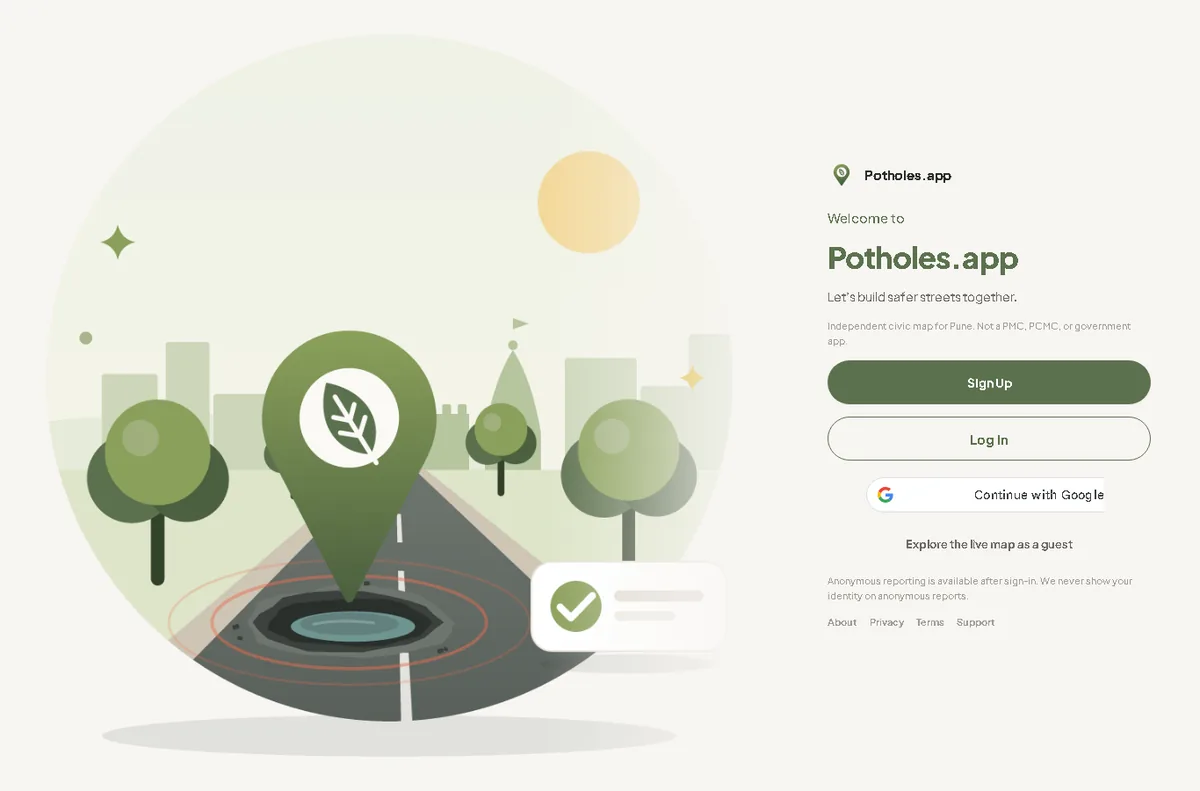
Every system in this quiz shares a blind spot. Signs describe permanent features and planned works: bends, crossings, schools, bridges. They say nothing about the crater that opened after last night's rain. A pothole is a hazard without a sign, often until someone gets hurt or reports it.
What you can do depends on where you live. In most cities the route is the road authority's own reporting channel: a council website in the UK, a 311 line in many US cities, a municipal app or helpline elsewhere. Report the exact spot, add a photo, and note the date.
In Pune and Pimpri-Chinchwad there is also a public record. Potholes.app is an independent map, not a PMC or government app, where residents can pin an unsigned pothole on the Pune civic map with a photo. Guests can browse; you sign in to report. Neighbours then mark each pin "still there" or "fixed", and the About page explains how neighbour confirmations work on the Pune pothole map.
A pin is only as useful as its photo. Before you share or trust one, run through a checklist for checking a Pune pothole photo before you trust it. And if you photograph your own street, read the location privacy tips for civic reporters in Pune first, because a phone photo can carry more about you than about the road.
Mistakes quiz hosts make with sign questions
- Asking about "the" stop sign. Ask about a country's stop sign. Otherwise the person from Tokyo is right and gets marked wrong.
- Mixing units without saying so. "What is the national speed limit?" needs a country and a road type.
- Treating local habits as international law. Blue motorway signs are a UK habit, not a Vienna rule. Italy signs its motorways in green.
- Copying sign images from random sites. Drawing blank shapes yourself is quicker and avoids rights questions.
- Using trick questions only. Mix easy shape questions with hard ones so every team scores.
- Forgetting the date. Party counts and manual editions change. Say when you checked.
If this happens on the night
- A team disputes an answer with their own country's rule. Check whether they are right for their country. If so, give the point and note the local difference. That is the best bit of a global sign round.
- Someone asks whether the road sign test is multiple choice. Explain that it varies by country and licensing authority, and that many written tests use multiple-choice questions. This quiz is free answer, which is harder.
- The room is too quiet. Switch to the shapes-on-a-screen format and let tables shout.
- Two teams tie after question 50. Ask the next closest numeric: the date the Vienna Convention came into force (6 June 1978).
- A learner driver wants more traffic sign questions and answers. Point them to their official handbook. Ours covers concepts, not the exact pool their test uses.
FAQ
Is the road sign test multiple choice?
In many places the written part of a driving test is multiple choice, including road sign questions, but formats differ by country and by state or province. Some tests show a sign and ask what it means, others mix signs into hazard scenarios. Check the official handbook from your licensing authority, which usually explains the format and lists the signs you must know. This road signs quiz is free answer, so it works as tougher practice.
What are international road signs categorized into?
Under the 1968 Vienna Convention, signs fall into eight categories lettered A to H: danger warning, priority, prohibitory or restrictive, mandatory, special regulation, information and services, direction and position, and additional panels. In practice most drivers only need four families: triangles warn, red circles forbid, blue circles order, and rectangles inform.
What is the difference between European road signs and American road signs?
European signs mostly follow the Vienna system: warnings are triangles, and orders are circles that rely on symbols. American signs follow the MUTCD: warnings are yellow diamonds, many regulations are written in words on white rectangles, and certain shapes are reserved for single meanings, such as the pennant for no passing zones. Stop and yield are nearly identical on both sides of the Atlantic.
Are European road signs in English?
Mostly they use symbols rather than words, which is the point of the Vienna system. Where words appear they are usually in the local language, with STOP the big exception: the Convention allows it in English or the national language, and many countries use the English word. Place names are local, so learn the local word for exit and city centre before you drive.
Can I use this quiz to study for a driving test?
Use it as a warm-up, not a replacement. This quiz covers how traffic signs work across systems, which helps you reason about unfamiliar signs. The exact road signs for driving test questions come from your licensing authority's handbook, with local signs and local wording. Do the official practice material too, and use this traffic sign quiz with answers to check you understand the logic behind the shapes.
Why are warning signs yellow in some countries and white in others?
The Vienna Convention allows either a white or a yellow ground for warning triangles, so countries choose. Sweden, Finland, Iceland, Poland and Greece are among those using yellow, and in Sweden the usual explanation is visibility against snow. The US, Australia and Ireland use yellow diamonds instead of triangles, while most of Western Europe sticks with white.
Is there a picture version of this quiz?
You can make one in minutes: draw blank shapes in a slide tool and ask what each one means before showing any symbol. For a picture round with famous faces instead, a Guess the Celeb round gives you ten crops with a reveal after each pick, and Compete lets up to ten players answer from their phones.
Where to go next
Sign questions are a good opening act. To close the night, switch from shapes to faces: start the room on an easy 10-face celebrity round, step up to the hard round with tighter crops, or put everyone's phone to work in a live multiplayer quiz for up to 10 players. The eyes-only round is the cruellest, and the faces are edited parody composites, so the reveal is part of the fun. Regulars can try the daily three-face round, which needs a free Google sign-in, or mix a prank quiz from the library. Building a team for the next league? Read how to build a pub quiz team, then browse more guides for quiz hosts.
And if you ride or drive in Pune, the next unsigned hazard you meet is worth a minute: open the map and check whether a Pune road hazard is still there or fixed before you set off.