Local Quiz Questions: How to Write a Quiz About Your City
Good local quiz questions do something a general knowledge round cannot: they make the room feel like insiders. The newcomer learns something, the person who grew up on the next street gets to be smug, and everybody argues about the old cinema.
The catch is accuracy. Local facts are where quiz nights go wrong, because the internet is full of copied "facts about my town" pages that disagree with each other. This guide shows how to write a local quiz from public sources, in ten round formats that work in any city, town or village, with a two-source fact-check and a worked civic round built from ward scorecards. It is written for hosts anywhere, with examples from London to Pune.
Key takeaways
- Write for the people in the room: newcomers and long-time residents need different questions.
- Build from public sources: city websites, open data portals, census tables, transport maps, library collections and your own walks.
- Ten formats cover almost any place: streets, landmarks, transport, numbers, nicknames, firsts, food, then-and-now, maps and civic questions.
- Check every answer in two independent sources. If they disagree, cut the question or ask about something they agree on.
- Date your answer sheet. Wards, mayors, tram lines and even district names change.
- Use your own photos for picture rounds, and credit any map data you borrow.
Contents
- What makes good local quiz questions
- Step 1: Pick your patch and your players
- Step 2: Mine public sources, not listicles
- Step 3: Ten round formats that work anywhere
- Twenty local quiz questions you can adapt
- Step 4: Write the question so it has one answer
- Step 5: Fact-check with two sources and a date
- Worked example: a civic round from ward scorecards
- Picture and map rounds without the rights headache
- How local quizzes change by city
- Which format for which crowd? A decision table
- Mistakes that sink a local round
- If this happens on quiz night
- FAQ
- Where to go next
What makes good local quiz questions
A good local question passes four tests.
- Residents have a fair chance. Someone who lives there should be able to reason their way to the answer, even if they do not know it. "Which line runs past the hospital?" beats "In what year was the third platform extended?"
- Outsiders can still play. At least half the questions should be gettable by a sharp newcomer, through clues in the wording or a multiple-choice option.
- It has one defensible answer. Local trivia questions attract pedants who grew up there. Your wording has to survive them.
- You can show where it came from. If someone challenges it, you can name the source and the date you checked.
The same rules sit behind how to write good quiz questions on any subject, and how to write trivia questions for a league. Local rounds just punish sloppiness faster, because the expert is sitting at table three. Our guide to running a regular quiz night covers the general craft; this one is about the local layer.
Step 1: Pick your patch and your players
Before you look up a single fact, decide two things.
How big is "local"?
A city is too big for a single round. Pick a patch: a neighbourhood, a borough, a high street, a ward, a bus route, a river. Smaller patches give better questions, because the facts are less googled and more lived.
Who is playing?
- Newcomers and expats: questions that teach the place. Transport, neighbourhood names, local words, the food everyone mentions.
- Long-time residents: then-and-now, closed shops, old names, who the street is named after.
- Mixed rooms: half and half, with multiple choice on the hard ones.
- Workplaces: the area around the office, the commute, the lunch spots.
Write the audience at the top of your answer sheet. It stops you drifting into questions only you care about.
Step 2: Mine public sources, not listicles
The fastest way to bad local trivia questions and answers is a "50 facts about this town" page. The fastest way to good ones is the sources those pages should have used.
| Source type | What it gives you | Watch out for |
|---|---|---|
| City or council website | Ward and district names, services, elected representatives, history pages | Pages updated after elections or boundary changes |
| Open data portal | Counts, lists and maps: trees, stations, parks, street names, complaints | Dataset dates; always note the year |
| National statistics office | Census figures by area: population, languages, age | Census years, and which boundary the figure uses |
| Transport operator | Line names, colours, station names, timetables | Renamed stations and closed lines |
| Library or museum local collection | Old maps, photos, street-name origins, local firsts | Claims repeated from one old book |
| Your own walk | Plaques, foundation stones, shop signs, murals, street furniture | Getting the spelling right |
Most big cities now publish an open data portal. The London Datastore describes itself as offering over a thousand datasets; New York, Paris, Toronto, Singapore and Melbourne run portals too. Smaller towns rarely have one, but the regional or national portal often holds the same tables by area.
Two sources to treat with care: encyclopedia mirrors, which copy one article's errors across dozens of sites, and old tourist leaflets, which are confident about legends.
Step 3: Ten round formats that work anywhere
These ten formats turn raw facts into local quiz questions and answers in any city, town or village. Each comes with a template you can fill in.
- Street names. "Who or what is [Street] named after?" Plaques and council naming records make this checkable.
- Landmarks from odd angles. "Which building has [unusual detail] on its roof?" Works as words or as a cropped photo.
- Transport. "Which station or stop is between [A] and [B]?" or "What colour is the [X] line on the map?"
- Numbers. "How many wards, boroughs or districts does the city have?" Closest wins, which keeps it fun when nobody knows.
- Nicknames and local words. "What do locals call [place]?" Brilliant for mixed rooms, because the newcomer learns the word.
- Firsts and records. "Where was the town's first [cinema, bridge, station]?" Only with two sources, because "first" claims are the most disputed.
- Food and drink. "Which neighbourhood is known for [dish]?" Avoid naming businesses unless the fact is about the place, not a promotion.
- Then and now. "What was on this corner before [current building]?" Library photos and old maps are gold.
- Map round. Hand out a blank outline and ask teams to mark five places. Score by distance.
- Civic round. "Which body fixes this road?" "How many councillors represent this ward?" The worked example below shows how to build one.
For a local history quiz, lean on formats 1, 6 and 8. For a local knowledge quiz aimed at newcomers, lean on 3, 5 and 9.
Twenty local quiz questions you can adapt
Fill in the blanks for your own patch, check each answer twice, and you have two rounds. These local quiz questions are deliberately generic: the facts come from your sources, not ours.
Ten local knowledge questions for any city
- Which river, canal or coast does the oldest part of [town] sit on?
- What do locals call [district] in everyday speech?
- Which two stations or stops are at either end of the [X] line or route?
- How many wards, boroughs or districts does [city] have today?
- Which neighbourhood is best known for [dish or market]?
- What is the name of the main park closest to [landmark]?
- Which body runs the buses, trams or metro in [city]?
- On which street is [civic building] found?
- What colour are [city]'s buses, taxis or bins? (Great for newcomers.)
- Which neighbouring town or city is closest to [town], by road?
Ten local history quiz questions
- Who or what is [street] named after?
- In which decade did [station, bridge or market] open? (Decades are safer than years.)
- What stood on [site] before [current building]?
- What was [district] called before its current name?
- Which industry gave [area] its early growth?
- Which event does the memorial on [square] commemorate?
- What was the original use of [converted building]?
- Which famous visitor, writer or performer is linked to [venue], according to its plaque?
- Which two towns or villages merged to form [today's town]?
- In which year did [city]'s current ward or district map take effect?
Questions 12, 18 and 20 are the ones most likely to start an argument. Use them only when your two sources agree, and keep the plaque photo handy.
Five filled-in examples, with answers
Here is what the templates look like once the blanks are filled, using facts covered elsewhere in this guide (checked 23 October 2026):
- How many London boroughs are there? 32. The City of London is not a borough, so "33" is only right if you asked about local government areas.
- How many boroughs does New York City have? Five, which is why a five-question New York round almost writes itself.
- How many arrondissements does Paris have? 20. Since 2020 the first four share one administration, Paris Centre, so accept a note about that.
- How many prabhags (electoral wards) did the 2026 Pune Municipal Corporation election use? 41, electing 165 corporators.
- Which two municipal corporations does a Pune civic round need to tell apart? The Pune Municipal Corporation (PMC) and the Pimpri-Chinchwad Municipal Corporation (PCMC).
Each one has a clean answer, a reason it is interesting, and a trap the setter has already thought about.
Step 4: Write the question so it has one answer
Most disputes come from wording, not facts. Anyone asking how to write quiz questions, or how to write good trivia questions, ends up at the same rules. Here they are for a local expert audience:
- Say exactly what you mean. "How many London boroughs are there?" has a clean answer of 32 because the City of London is not a borough. Ask "how many local government areas" and the answer becomes 33, because the City counts as one. Decide which question you are asking.
- Anchor it in time. "How many arrondissements does Paris have?" is 20. But since 2020 the first four have shared one administration called Paris Centre. Ask about the number of arrondissements, not "districts", or write both answers on the sheet.
- Avoid "biggest", "oldest" and "first" unless your sources use those exact words. These are where local claims fall apart.
- Give a range for numbers. "Within 10%" or "closest wins" prevents a shouting match over a census figure.
- List acceptable answers in advance. Old and new names, local spellings, abbreviations.
- Read it aloud before the night. If you stumble, a team will misunderstand it.
This is also how to write pub quiz questions in general: one fact, one answer, no traps that rely on a technicality only the setter knows. If you are working out how to make a quiz from scratch for the first time, start with these rules and the twenty local quiz questions above, then add your own.
Step 5: Fact-check with two sources and a date
The rule that saves most local rounds: every answer appears in two independent sources, and at least one of them is not a copy of the other. An encyclopedia and a site that quotes the encyclopedia count as one.
When sources disagree, do not pick a favourite. When we built our Pune quiz questions with answers, local sources gave different years for when a famous palace was built and when it burned. Those questions were cut, and the round asked about things the sources agreed on instead.
Then add a date. Write "answers checked on [date]" at the top of the sheet. Anything about elected officials, ward boundaries, transport lines or opening hours can change within a year.
Keep a simple source sheet. It takes ten minutes and wins every argument:
| Question | Answer | Also accept | Source one | Source two | Checked |
|---|---|---|---|---|---|
| 4 | [number] | Within 10% | Council website page | Census table for the area | [date] |
| 11 | [person] | Surname only | Street-name plaque (your photo) | Library naming record | [date] |
| 14 | [old name] | Old spelling | Old map in the library | Local history society page | [date] |
If a row has an empty "source two" column on the morning of the quiz, that question does not go in.
Worked example: a civic round from ward scorecards
Civic questions are underused in local quizzes, partly because they sound dull. They do not have to be. Here is a round built from public ward scorecards in Pune, which works as a template for any city that publishes ward or district performance figures.
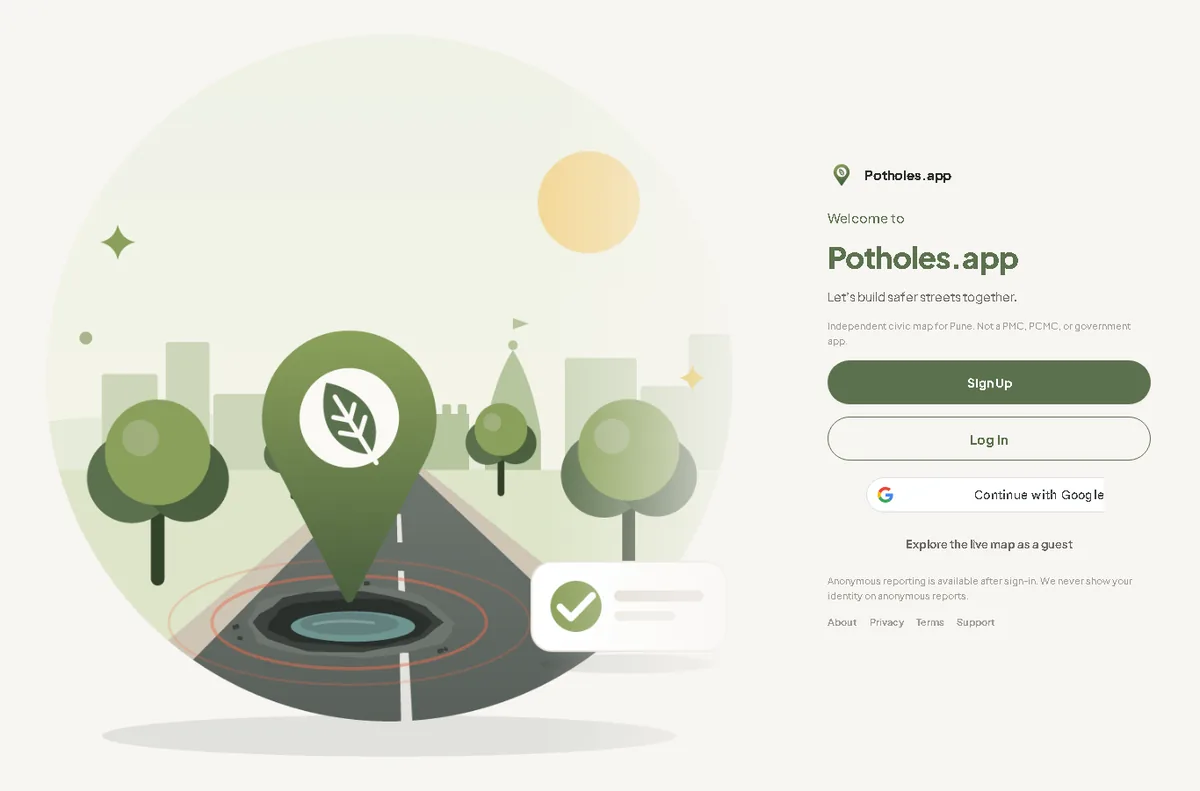
Potholes.app is an independent Pune and Pimpri-Chinchwad civic map that is not a PMC app. Residents pin road hazards with a photo, neighbours mark them still there or fixed, and the app summarises the pins by ward. Before the night, check live ward scorecards for Pune and PCMC and write down the figures you will use, with the date.
The scoring rule is public, which makes it perfect quiz material. Each ward with reports gets a score out of 100: 60% comes from the resolution rate, and 40% from how fast fixes happen, where a same-day fix scores 100 and an average of 30 days or more scores 0. Scores of 70 and above are "Doing well", 40 to 69 is "Mixed", and below 40 is "Failing citizens". The guide on how Pune ward scores are calculated and misread explains the method and its traps.
Sample questions, using hypothetical wards so the answers never go out of date:
1. A ward has resolved 8 of its 10 reports, with an average fix time of 15 days. What is its score?
Answer: 68. Resolution is 80%, worth 48 points. Fifteen days scores 50 for speed, worth 20 points.
2. Which band is that?
Answer: Mixed. It needed 70 for "Doing well".
3. Another ward resolved only 2 of 4 reports, but fixed both the same day. Which ward scores higher?
Answer: The second, with 70: 30 points for resolution plus 40 for speed. It is a lesson in how small numbers swing a ranking.
4. A ward's fixes take 30 days on average. How many points does it get for speed?
Answer: Zero.
Then add one or two live questions from the scorecard on the day, such as which of three named wards currently ranks highest. Pair them with a question on representation: the About page explains how the Pune pothole map shows who represents each pin, using the November 2024 MLA roll and the January 2026 civic election results. Our Pune round used the same election for its civic questions: 41 prabhags and 165 corporators for the Pune Municipal Corporation.
Elsewhere, the same format works with any published scorecard: council complaint response times, school inspection grades, park counts by district. Ask about the method, not just the ranking, and the round stays useful.
Picture and map rounds without the rights headache
Pictures lift a local round, and they bring two questions: whose image is it, and do you need to credit it?
- Use your own photos where you can. A tight crop of a plaque, a door, a roofline or a street sign is easy to take and easy to clear.
- Borrowed maps need credit. OpenStreetMap's copyright page says you are free to copy and adapt its data under the Open Database License, as long as you credit OpenStreetMap. Put the credit on the slide.
- Check every borrowed image. Wikimedia Commons guidance on reusing images is clear that each file carries its own licence and terms. Read them per file.
- Mapped data makes a good round. In Pune you can browse pinned road hazards on the Pune civic map and ask teams which of four roads has the most open pins that week. Note the date and accept that it changes.
For faces, the rules are stricter. Do not put photos of private people in a quiz without asking them. If you want a celebrity round to finish the night, Guess the Celeb rounds use edited parody composites with a reveal after each pick: try the hair-only round, or browse our picture round ideas beyond famous faces for objects and places.
How local quizzes change by city
The method is the same everywhere. The raw material, and the trap questions, change a lot. Eight examples:
- London. Thirty-two boroughs, created in 1965, plus the City of London, which is not a borough. That one distinction powers a whole round of questions about my city for Londoners. The London Datastore covers the rest.
- New York. Five boroughs give you an instant round structure: one question per borough, then a tiebreaker. NYC Open Data is the place to look for counts and lists.
- Paris. Twenty arrondissements numbered in a clockwise spiral from the centre, a gift for map rounds. Remember the 2020 Paris Centre change for the first four.
- Toronto. The city publishes ward profiles built from census data for the 2022 to 2026 council term. Good for "which ward has more of" questions, with the census year stated.
- Singapore. The national portal, data.gov.sg, holds thousands of government datasets, so a local round can draw on official figures for almost any neighbourhood question.
- Melbourne. The City of Melbourne runs its own open data portal, handy for a round about the central city, as long as you note each dataset's date.
- Pune. Two municipal corporations, PMC and PCMC, and a civic round built from ward scorecards. If your quiz group likes getting outside, plan a morning road walk to survey your Pune street and turn what you find into next month's picture round.
- A small town or village. No portal, but a parish or town council website, a war memorial, a church guide and the library's local history shelf. Village quiz questions often come from one afternoon with the archivist.
Which format for which crowd? A decision table
| Crowd | Best formats | Avoid | Length |
|---|---|---|---|
| Newcomers and expats | Transport, nicknames, food, map | Deep history, old shop names | 8 to 10 questions |
| Long-time residents | Then and now, street names, firsts | Questions any newcomer would get | 10 questions |
| Office near the city centre | Landmarks, lunch spots by area, transport | Anything about named colleagues | 8 questions |
| Village fete or town event | Street names, local history, numbers | Contested local politics | 10 to 15 questions |
| Online quiz with people who moved away | Then and now, photos, nicknames | Current opening hours | 10 questions |
| Civic or residents' group | Civic round, numbers, map | Party politics | 8 questions |
If your league already has strong teams, our notes on how to build a pub quiz team explain why a local specialist is worth recruiting.
Mistakes that sink a local round
- Copying a facts list. If ten sites share the same sentence, they share the same error.
- Asking what only you know. "What was my school's old name?" is not a quiz question.
- Undated civic answers. Mayors and ward counts change. Date the sheet.
- Contested history as a one-word answer. If historians argue, so will table three. Ask about something agreed.
- Naming private people. Shopkeepers, neighbours and local characters did not agree to be quiz answers.
- Too many numbers. Two per round is plenty, with closest-wins scoring.
- No newcomer route. If half the room cannot score, they will not come back to your local quiz nights.
If this happens on quiz night
- A resident says your answer is wrong. Show the two sources and the date. If they have a better source, thank them and award the point. Update the sheet afterwards.
- Two old names are both "right". Accept both. Write them on the sheet next time.
- A live figure changed since you checked. Give the point to the answer that matched on your check date, then share the new number. It makes a good talking point.
- The room goes quiet on a hard round. Switch to multiple choice on the spot: read three options for each remaining question.
- Teams finish early. Run a map round as a bonus. Everybody can point at a map.
FAQ
How do you write good quiz questions?
Make each question about one fact with one answer, word it so a careful reader cannot argue, and check the answer in two independent sources. Mix difficulty so every team scores, and give numbers a range. Read every question aloud before the night. For local rounds, add a date to the answer sheet, because local facts change faster than general knowledge.
How many questions should a local quiz have?
For a single round of local quiz questions inside a general quiz, eight to ten questions. For a whole night about one town, four or five rounds of eight to ten, with different formats: one picture round, one map round, one numbers round and a mix of words. Keep each round under fifteen minutes including marking.
Where can I find local trivia questions and answers?
Write your own from public sources rather than copying lists. Start with your city or council website, then the open data portal if there is one, the national census tables by area, transport maps and your library's local history collection. A walk with a notebook turns up plaques and foundation stones that no list has. Check every answer twice.
How do I write a local history quiz without getting dates wrong?
Only use dates that two independent sources agree on, and ask about the event rather than the exact day where sources differ. Prefer primary sources such as foundation stones, council records and dated newspaper reports. If an "oldest" or "first" claim only appears in one book or on copied web pages, leave it out. A local history quiz with answers you can defend beats a dramatic one.
Can I use photos of my town in a picture round?
Your own photos are the safest choice. For anything else, check the licence of each image and follow its terms, including credit. Map data from OpenStreetMap can be used if you credit it. Avoid photos of identifiable private people unless they have agreed, and crop out faces and number plates in street shots.
What makes a good local knowledge quiz for newcomers?
Questions that teach the place: how transport works, what locals call neighbourhoods, which area is known for which food, where the main parks and markets are. Use multiple choice so nobody is stuck at zero. A map round works brilliantly, because newcomers learn the layout while they play.
How do I make a quiz about my town for a village or town event?
Start with the parish or town council website, the war memorial, any church or heritage guide, and the local library. Village quiz questions and town quiz questions work best on street names, local history and numbers, with one picture round of your own photos. Avoid current local disputes, and print the answers with the sources so people can take them home.
Where to go next
A local round is the best opening act a quiz night can have. Close with something everyone can play, wherever they grew up: start on an easy celebrity round, mix your own prank quiz from the library and share the link, or run the finale live with Compete for up to 10 players on their phones. More host guides are on the Guess the Celeb blog.
If you are writing a Pune round, take the quiz outside afterwards: walk the streets your questions came from and pin a hazard you spot on your Pune quiz walk. Next month, it could be a question.